When people prepare for interviews, they often end up doing one thing over and over again: trying to present themselves as impressively as possible.
You start polishing your achievements.
You make your impact sound sharper.
You try to sound more confident, more accomplished, more complete.
And without noticing it, interview preparation can slowly become an exercise in self-promotion.
But after doing enough interviews, either as a candidate or as an interviewer, you begin to notice something else.
An interview is not only a place to prove that you are capable.
It is also a place where people imagine what it would feel like to work with you.
That is why the people who leave the strongest impression are not always the ones with the flashiest stories.
Sometimes they are the ones who make you think:
“This person feels honest.”
“They do not pretend to know everything.”
“They seem easy to work with.”
“If something goes wrong, they probably will not turn defensive or blame others.”
In the end, what matters in an interview is not just whether you can make yourself look impressive.
It is whether you can make someone trust you as a future teammate.
Looking impressive is not the same as feeling trustworthy
Interviews make almost everyone tense.
And when people get tense, they usually move in one of two directions.
Some people shrink.
They downplay what they have done, speak too cautiously, and fail to show the real value of their work.
Others go the opposite way.
They exaggerate.
They talk about team achievements as if they were individual wins.
They describe messy learning experiences as if they had known the right answer from the beginning.
Both reactions are understandable.
An interview is, after all, an evaluation.
But from the interviewer’s side, the more convincing person is often neither the quietest nor the most polished.
It is usually the person who can clearly say what they did, what they did not know, and what they learned along the way.
Take failure, for example.
One candidate may try to hide the mistake and move quickly to the recovery.
Another may say something like this:
At the time, I was looking at the problem too narrowly from a technical perspective.
What mattered more was the user impact, and I realized that too late.
After that, I changed how I prioritize problems. Now I start by clarifying who is affected and how.
That answer is not dramatic.
It does not try to sound brilliant.
But it feels solid.
Why? Because it shows self-awareness.
It shows honesty.
It shows that the person is not only reporting outcomes, but also reflecting on judgment.
And that kind of reflection tends to build trust faster than polished confidence.
An interview is not only a test of skill. It is also a test of collaboration.
Most people treat interviews as skill assessments.
That makes sense. Skill matters.
But interviewers are usually evaluating more than technical ability.
They are also asking themselves quieter questions.
What happens when this person disagrees with someone?
Can they explain their thinking clearly?
Do they listen?
Will they be constructive under pressure?
Do they take ownership, or do they protect themselves first?
Would this person make the team better to work with?
That is why attitude shows up so strongly in interviews, even when no one says it directly.
For example, when talking about a project, there is a big difference between these two styles:
“I built the whole thing myself.”
and
“I led this part, a teammate owned another major part, and we had to work through a disagreement about priorities before we moved forward.”
The second answer does more than describe work.
It reveals how the person works with other people.
And in most real jobs, that matters just as much as individual brilliance.
A strong interview is not only about saying, “Here is why I am good.”
It is about showing, “Here is what it feels like to solve problems with me.”
That difference matters more than many people realize.
What interviewers look for changes by level
Another thing that often gets overlooked is that not every interview is asking for the same kind of signal.
The qualities that matter in a junior interview are not the same ones that matter in a senior or principal interview.
The question may sound similar, but the expected depth is different.
Junior: potential, learning, and coachability
For junior candidates, interviewers are rarely looking for a finished product.
They are not expecting complete mastery.
They are trying to understand whether this person can grow in a healthy direction.
That usually means looking for things like:
Can this person learn quickly?
Can they take feedback without collapsing or getting defensive?
Do they have solid fundamentals?
Can they follow through?
Do they know when to ask for help?
Because of that, junior candidates do not need to force every answer into a story of huge impact.
What often matters more is how they learn.
A strong junior answer sounds something like this:
At first, I misunderstood the root cause.
After reviewing the logs again and asking for help, I realized I had locked onto my first assumption too quickly.
Since then, I have tried to separate what I know from what I think I know before jumping into a fix.
That answer is not trying to sound heroic.
It is showing a healthy growth pattern.
And that is often what interviewers want to see at the junior level.
A junior interview is not mainly about how much you have already done.
It is about whether you look like someone who will keep getting better.
Senior: independence, judgment, and impact
At the senior level, the bar changes.
Now it is not enough to be a strong executor.
You are expected to create clarity where things are ambiguous, make decisions with incomplete information, and move work forward across people and priorities.
Interviewers are often looking for independence and leverage.
Can this person define the real problem, not just respond to the surface request?
Can they make tradeoffs?
Can they coordinate with others effectively?
Can they improve outcomes beyond their own individual tasks?
That means a strong senior answer usually includes more than implementation details.
It explains:
Why the problem mattered.
How priorities were set.
What tradeoffs were considered.
Who needed alignment.
What changed because of the work.
For example:
The original request was framed as a feature gap, but after digging in, it became clear that the bigger issue was inconsistent data quality.
I suggested we align on definitions first instead of immediately building on top of unstable assumptions.
It looked slower in the short term, but it reduced repeated issues later and gave other teams a shared foundation too.
That answer shows more than competence.
It shows judgment.
It shows the ability to reframe a problem and create broader impact.
That is what senior-level interviews are usually trying to surface.
A senior person is not just someone who does good work.
It is someone who helps make good work happen.
For roles beyond senior level: direction, systems thinking, and organizational influence
For roles beyond senior level, the frame shifts again.
The conversation is no longer mainly about whether you can solve difficult problems yourself.
It is about whether you can shape how an organization solves problems.
Now the scope is larger.
The timelines are longer.
The tradeoffs are more complex.
Interviewers may be looking for signs like these:
Can this person think across teams, not just within one area?
Can they connect technical decisions to organizational consequences?
Can they create alignment without relying on direct authority?
Can they build systems, principles, or structures that continue working even after they step away?
A strong principal answer often sounds different from a senior one.
It is less about “Here is the decision I made,” and more about “Here is the environment I helped create so that better decisions could happen consistently.”
For example:
What looked like a performance issue at first turned out to be a coordination problem across teams with different operating assumptions.
Instead of optimizing one service in isolation, we introduced a shared decision framework and common reliability standards.
That reduced repeated debates and helped teams make faster, more consistent tradeoffs on their own.
That is not just problem-solving.
That is organizational design.
This level candidate is not only expected to bring answers.
They are expected to help the organization produce better answers over time.
The same question carries different weight at different levels
Imagine the question:
“What is the hardest problem you have solved?”
A junior candidate should probably focus on how they approached it, where they got stuck, what they learned, and how they improved.
A senior candidate should probably talk about problem definition, prioritization, collaboration, tradeoffs, and measurable impact.
A principal candidate should probably go one level higher and explain why the problem mattered at an organizational level, what long-term change came out of it, and how it shaped systems beyond one immediate win.
The wording of the question may stay the same.
But the expected layer of thinking changes.
And this is where many candidates struggle.
A junior candidate may try too hard to sound strategic and forget to explain what they actually did.
A senior candidate may spend too much time on implementation detail and not enough on judgment or influence.
A principal candidate may tell strong execution stories without showing organizational direction.
That is why interview preparation is not just about practicing answers.
It is about understanding what the role is really asking you to represent.
In the end, interviews leave an impression of a person, not just an answer
After an interview is over, most people do not remember every sentence.
What they remember is the shape of the person.
They remember whether you seemed grounded.
Whether you sounded honest.
Whether you gave credit to others.
Whether your thinking felt mature.
Whether it was easy to imagine working with you.
That is why the strongest interviews often do not feel like performances.
They feel like clear windows into how someone works.
Not perfect.
Not over-rehearsed.
Just clear.
I think that is what many candidates miss when they prepare only for “good answers.”
Good answers matter, of course.
But answers alone do not create trust.
What creates trust is something deeper:
a sense that you understand yourself, your work, your strengths, your limitations, and the way you show up on a team.
When someone can speak from that place, the interview becomes less about selling and more about clarity.
I work this way.
This is where I am strongest.
This is where I have made mistakes.
This is how I have changed.
This is the kind of teammate I try to be.
Those are not flashy ideas.
But they are often the ones that stay with people.
Interview preparation is really a form of self-understanding
This is why I think interview preparation is more personal than most people admit.
At its best, it is not just about learning how to answer common questions.
It is about finding language for who you are at work.
What kinds of environments help you do your best work?
What kinds of people bring out your strengths?
What situations make you defensive?
What kind of contribution do you make repeatedly?
What values show up in the decisions you make?
These are not typical interview prep questions.
But they may matter more than most of the tactical ones.
When people do not understand themselves well, they tend to reach for impressive-sounding language.
When they do understand themselves, their answers often become simpler and more believable.
And interviewers can usually feel the difference.
So before trying to sound sharper, bigger, or more polished, it may be worth doing something harder: understanding yourself more clearly.
Because in the end, a good interview is not only about whether you can answer well.
It is also about whether another person can see you clearly enough to trust working with you.
A book worth reading is not one about interview tricks, but one that helps you reflect on yourself
There are many books that teach interview tactics.
Some are useful.
They can help with structure, communication, and confidence.
But sometimes a more helpful book is not one that teaches you how to perform better.
It is one that helps you think more honestly about who you are.
That is why a book like The Book of Questions by Gregory Stock feels relevant here.
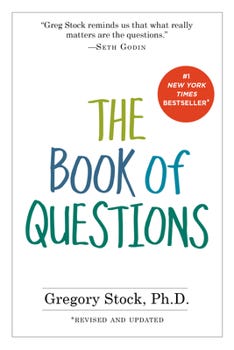
It is not an interview book.
It does not teach you how to answer behavioral questions or negotiate an offer.
Instead, it asks questions that make you reflect on your values, fears, choices, relationships, and inner contradictions.
And that kind of reflection may actually be closer to the heart of good interviewing than most advice books are.
Because strong interviews do not begin with polished answers.
They begin with self-knowledge.
Not: “What sounds impressive?”
But: “What do I actually believe?”
“What kind of person am I when I work with others?”
“What matters to me?”
“What am I still learning about myself?”
Maybe that is what interview preparation really is, at its deepest level.
Not just preparing to be chosen.
But understanding more clearly what kind of person you are becoming at work.
 Site Title