[AEE] Episode 2504 – How to Blend Your Social Bubbles in English

🗣️ Refined Daily Expressions & Idioms (with Examples)

1. Blend your social bubbles

Meaning: Bring together people from different parts of your life (work, school, hobbies, etc.).
Example:
“I’m hosting a game night next weekend—I figured it’s time to blend my social bubbles.”


2. Have you guys met? / Have you both met?

Meaning: A casual and easy way to initiate introductions.
Example:
“Oh hey! Have you guys met? This is Jake—he and I work together.”


3. You should talk to [someone]

Meaning: A soft prompt to connect two people who may have something in common.
Example:
You should talk to Rachel—she just got back from Portugal too!”


4. He/She’s the one I was telling you about…

Meaning: Referring back to a previous conversation; a useful intro with context.
Example:
“That’s Sarah—she’s the one I was telling you about who started her own design firm.”


5. I’ve been wanting to introduce you to…

Meaning: Expresses intentionality and builds positive anticipation for the meeting.
Example:
I’ve been wanting to introduce you to Liam—he’s also into photography.”


6. Give them a reason to talk

Meaning: As a host or mutual friend, provide a shared interest to start the conversation.
Example:
“You both love cooking, so I thought you’d hit it off. You both love trying new recipes.”


7. Weak ties

Meaning: Social science term for acquaintances or people one knows casually; often powerful in networking.
Example:
“Surprisingly, I got my job through a weak tie—a friend of a friend I met once at a dinner party.”


8. Off to the races

Meaning: Used informally to describe something that gets going quickly or easily.
Example:
“As soon as I mentioned they both ski, they were off to the races talking about mountain resorts.”


🎭 Role Play Script: Birthday Party Introduction

Setting: A birthday party. Lindsay (host) sees her friend Aubrey talking with her, and another friend, Mark, arrives.


Lindsay: Oh hey Mark! Glad you made it.
(turns to Aubrey) Have you guys met? This is Mark. He and I know each other from running club.

Aubrey: No, I don’t think we’ve met. Hi!

Mark: Hi, nice to meet you.

Lindsay: Aubrey and I are college friends. Actually, you guys have a lot in common—you both rock climb.

Mark: That’s awesome. Where do you climb?

Aubrey: Mostly at Phoenix on the Rocks, but I boulder outside sometimes. What about you?

Mark: I love Phoenix on the Rocks! You’ll have to tell me about your bouldering spots—I don’t know many.

Lindsay: Oh, and Aubrey—Mark’s the one I was telling you about who writes for The New Yorker.

Aubrey: Oh wow—I’ve been wanting to meet you. Lindsay mentioned your articles!


📝 Integrated Paragraph Using All Expressions

Last weekend, I hosted a fall-themed dinner party and decided it was time to blend my social bubbles. I had friends from work, my hiking group, and my writing class all under one roof. As soon as people started arriving, I went into host mode—“Have you guys met?” became my go-to line. At one point, I spotted Tara and Nia standing near the fireplace, so I said, “You should talk to each other—you both just got back from Iceland!” Later, when Mike showed up, I smiled and said, “Oh, he’s the one I was telling you about who just opened a coffee shop downtown.” I walked him over to Jenny, saying, “I’ve been wanting to introduce you to Jenny—she roasts her own beans at home.” Moments later, they were deep in conversation, totally off to the races. It was a perfect reminder of how valuable those weak ties can be—for new friendships, fresh ideas, and maybe even future collaborations.


[ABAD] The Psychology of Money – The Quiet Power of Money:

Why Freedom, Not Riches, Should Be Your Financial Goal

“Wealth is what you don’t see.”
— Morgan Housel, The Psychology of Money


Why We Get Money So Wrong

Most of us think money is about math: income, investing, interest rates.
But in The Psychology of Money, Morgan Housel reminds us something deeper.

Money isn’t math. It’s behavior. It’s psychology. It’s deeply personal.

It’s about how you handle fear, desire, patience, and pride.
That’s why two people with the same income can live completely different financial lives.

This book doesn’t tell you how to make money.
It teaches you how to think about it.
And in doing so, it shows you how to find something even more valuable: freedom.


1. Wealth Means Freedom, Not Stuff

Here’s a hard truth.

Driving a luxury car shows that you spent money.
Having money in the bank or invested quietly? That’s real wealth.

“Spending money to show people how much money you have
is the fastest way to have less money.”
— Morgan Housel

True wealth is invisible.
It’s not flashy or loud.
It’s the ability to say things like:

  • “No, I don’t want to do that.”
  • “Yes, I’ll take the afternoon off.”
  • “I’ll live life on my terms.”

2. Behavior Is More Important Than Intelligence

You don’t need a finance degree to build wealth.
You need patience, consistency, and emotional control.

“Doing well with money has little to do with how smart you are
and a lot to do with how you behave.”

A janitor who saves for 40 years can become wealthier than a doctor who overspends.
What matters most is not how much you earn but how well you manage your behavior.

Small, smart choices repeated over time matter more than clever strategies.


3. Save, Not to Buy, But to Be Free

“Saving money isn’t about sacrifice. It’s about creating space.”
— Heegu Song

Most people save money to spend it later.
But both Morgan Housel and Korean author Heegu Song challenge that idea.

They believe saving is not about delayed consumption.
It’s about building a buffer between you and stress.
It’s about creating space, not things.

“The highest form of wealth,” Housel writes,
“is the ability to wake up every morning and say,
‘I can do whatever I want today.’”

Heegu Song lives this way every day.
Even after achieving financial independence, he wakes up before dawn,
takes public transportation, and arrives at the office before anyone else.

He does this not because he has to but because he chooses to.
He values simplicity, structure, and self-discipline.

Each small act, like riding the train instead of driving or working when no one expects him to,
is a reminder to himself.

“I’m not doing this because I have to. I’m doing it because I choose to.”

Saving becomes less about giving things up and more about protecting your future energy.
It gives you room to make better choices and live with more intention.


4. Luck, Risk, and Humility

The book also explores two often overlooked truths about money: luck and risk.

Bill Gates became Bill Gates partly because his high school had a computer,
which was extremely rare at the time.

On the other hand, many smart investors fail simply because of bad timing.

The lesson is clear.

You don’t always succeed just because you’re smart.
And you don’t always fail because you made bad decisions.

Be humble. Be kind. Give yourself and others grace.


5. Focus on What You Can Control

You can’t control the economy, inflation, or the stock market.
But you can control:

  • How much you save
  • How you react to uncertainty
  • What you spend on
  • Who you try to impress

These daily decisions may seem small,
but over time, they shape your entire financial life.

And more importantly, they shape your peace of mind.


Final Thought: Real Wealth Is Quiet

Many people chase money hoping it will bring them freedom.
But Morgan Housel and Heegu Song show us a better path.

Freedom doesn’t come from earning more.
It comes from needing less, choosing wisely, and living intentionally.

Wealth isn’t the expensive car.
It’s the car you didn’t buy, the morning you kept for yourself,
and the time you spent thinking clearly because your life wasn’t ruled by money.

Real wealth is quiet.
It’s not something you show off.
It’s something you feel — when you finally have the space to choose.


📌 Save this post if you want to feel more at peace with your money.

Next time, we’ll explore why doing less can sometimes make you richer.

Would you like this post prepared in Markdown for Medium?
Or are you thinking about turning this into a series on time, money, and freedom?
Let me know. I’m here to help you build it. ✨

[AEE] Episode 2503: 3 Powerful Tips for Thriving in a New Language by Ingrid Piller

Whether you’re starting over in a new country or learning a language for daily life, Ingrid Piller, author of Life in a New Language, shares three essential insights from her decades of research with immigrants.

These are not your usual grammar tips. These are life strategies for real-world language growth.


1. Learning a Language Means Becoming a New Version of Yourself

“It’s not just about language. It’s about becoming a new person.”

📌 What It Means: Language learning is not only about passing tests like IELTS or TOEFL. It is about creating a new identity in a new culture, with new ways of thinking and interacting.

How to Use It:

  • Be open to change in how you express yourself and how others see you.
  • Understand that your personality might shift when speaking a new language.
  • Don’t try to keep everything the same. Growth is part of the process.

💬 Try This: Think about how your voice or humor changes in your new language. Accept it as part of who you are becoming.


2. Step Outside Your Comfort Zone and Talk to People

“You have to put yourself out there. Even if it’s awkward.”

📌 What It Means: You can’t learn to speak well by staying silent or relying only on language apps. Real conversation is where the real learning happens.

How to Use It:

  • Make small talk at the grocery store or while waiting for the bus.
  • Don’t worry about mistakes. Focus on the connection.
  • Build casual friendships with people who will talk to you regularly.

💬 Try This: Make it a habit to speak with one new person each day, even if it’s just a quick hello or comment.


3. Be Patient. Fluency and Belonging Take Time

“You’re playing a long-term game.”

📌 What It Means: Language confidence and feeling at home won’t happen right away. They build slowly, through daily effort and time.

How to Use It:

  • Give yourself permission to be a beginner.
  • Know that even advanced speakers still learn new things.
  • Focus on the relationships you are building, not just the grammar.

💬 Try This: Keep a language journal where you note your progress each week. Celebrate small wins.


🎯 Final Thought: Connection Is More Important Than Perfection

Ingrid Piller’s research reminds us that learning a new language is not just about speaking correctly. It is about creating a new life. That means finding your voice, your people, and your place in a new world.

If you’re learning a language today, be kind to yourself. You are not just learning new words. You are building a new version of your life.

🌟 Refined Daily Expressions & Idioms with Examples

These expressions from the script can elevate your real-world communication, especially for immigrants or long-term residents dealing with identity, communication, and belonging.

1. Put yourself out there

Meaning: To take risks socially, even if it feels uncomfortable or intimidating.
Example: “If you want to make new friends in your new country, you have to put yourself out there.”

2. Cold shoulder

Meaning: To be ignored or treated with indifference.
Example: “Sometimes when I try to talk to someone in English, I get the cold shoulder.”

3. Growing pains

Meaning: The difficulties experienced in the process of change or growth.
Example: “Learning a new language as an adult comes with growing pains, but it’s part of the process.”

4. Set yourself up for success

Meaning: To take actions that increase your chances of achieving your goals.
Example: “Immersing yourself in the local culture can really set you up for success.”

5. A sense of belonging

Meaning: Feeling accepted and connected to a group or place.
Example: “It took time, but I eventually found a sense of belonging in my new city.”

6. Play the long-term game

Meaning: To have a long-term perspective and patience in pursuing goals.
Example: “You’re playing a long-term game with language learning—it’s not going to happen overnight.”

7. Strike up a conversation

Meaning: To start a conversation, often with a stranger.
Example: “I tried to strike up a conversation while waiting for coffee.”

8. Stand out

Meaning: To be noticeably different.
Example: “Even after years in the country, my accent makes me stand out.”

9. Under siege

Meaning: Feeling constantly attacked or pressured.
Example: “Some migrants feel under siege when they’re frequently questioned about their origins.”

10. Get comfortable in a new language

Meaning: To feel confident and natural using the language in daily life.
Example: “It took years, but I finally got comfortable in my new language.”


🎭 Role Play Script

Here’s a short role play using expressions from the interview:


Characters:

  • Elena – A newcomer from Spain, recently moved to the U.S.
  • Maya – A long-term resident who immigrated from India 10 years ago.

Elena: Honestly, Maya, I thought I was ready. I’ve studied English for years. But out here… I don’t know. I feel like I stand out everywhere I go.
Maya: I totally get it. I went through the same thing. It takes time to get comfortable in a new language.
Elena: It’s not just the language. It’s like… I’m becoming a different person.
Maya: Exactly. You’re creating a new identity. And remember, you’re playing the long-term game here.
Elena: Still, sometimes I try to strike up a conversation and get the cold shoulder.
Maya: Oh yeah, that happens. But don’t take it personally. You’ve got to put yourself out there. The growing pains are real, but they pass.
Elena: I guess I just need to focus on building a sense of belonging.
Maya: Absolutely. Connect with people, even small chats at the store. Those water-cooler moments matter. Set yourself up for success by being present—even if it’s uncomfortable at first.
Elena: Thanks, Maya. You made me feel less alone.
Maya: You’re not under siege, Elena. You’re on your journey—and you’ve got this.


📝 Paragraph Using All the Expressions

Moving to a new country means playing the long-term game. It’s not just about mastering grammar—it’s about building a new identity and getting comfortable in a new language. There will be growing pains, like the awkward moments when you strike up a conversation and receive the cold shoulder. But to set yourself up for success, you need to put yourself out there. It’s natural to stand out at first, and sometimes that might make you feel under siege, especially if people constantly ask, “Where are you from?” Yet over time, by embracing those challenges and connecting with others, you’ll build a sense of belonging that makes all the effort worthwhile.

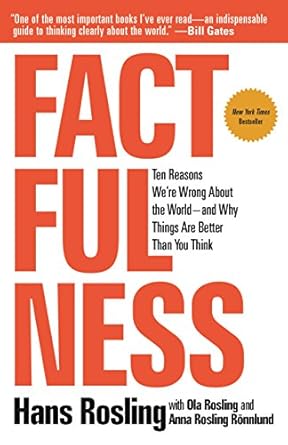
[ABAD] Factfulness – Why We’re Wrong About the World and What a Swedish Doctor Can Teach Us About It

This article is inspired by the book Factfulness by Hans Rosling, a brilliant global health expert who spent his life challenging the way we see the world.


In Factfulness, Rosling doesn’t just present data. He presents a mirror.
A mirror that shows us how wrong our instincts can be about poverty, education, global development, and even what “progress” really looks like.

The surprising part?

It’s not that we don’t know enough facts.
It’s that the facts we think we know are often completely wrong.
And even more surprisingly, we’re wrong in the same direction.

That direction is the negative one.


📉 When Even Experts Get the Basics Wrong

Rosling spent years asking thousands of people across the world, including Nobel Prize winners, CEOs, and policymakers, a set of 13 basic questions about global trends.

For example:

  • What percentage of girls in low-income countries finish primary school?
  • What is the global average life expectancy?
  • How has extreme poverty changed over the past 20 years?

These were multiple-choice questions. Even random guessing should give a 33 percent score.
But in reality, most people scored lower than that.

The average score was less than 20 percent.

Worse than a chimpanzee randomly selecting answers.

This wasn’t just a case of ignorance.
It was a clear sign of systematic misunderstanding.

People assumed the worst. That the world is getting poorer, sicker, and more dangerous.


🌍 The World Is Getting Better (Even If We Don’t See It)

Here are some facts from the book that most people get wrong:

  • 90 percent of the world’s children are vaccinated.
  • More girls are in school than ever before.
  • Extreme poverty has dropped by more than half since 1990.
  • Global life expectancy has risen to over 70 years.

So why do we still believe the world is in decline?

Because our brains are wired to pay attention to fear, drama, and worst-case scenarios.
Rosling describes this as a set of ten instincts that cloud our thinking.
These include the negativity instinct, the gap instinct, the fear instinct, and the blame instinct.

Each one shapes how we see the world. And not in a good way.


🧱 What Incomplete Houses in Tunisia Taught Me

There’s a story from the book that really stuck with me.

When tourists visit Tunisia, they often see houses that look half-finished.
Walls without roofs. Exposed bricks. Construction left incomplete.

And the common reaction?

People assume the locals are lazy or poorly organized. That they simply gave up.

But here’s the truth.

In places where banks can’t be trusted and inflation eats away at savings, people use a different strategy.
They buy bricks whenever they can afford them.

Instead of storing the bricks and risking theft, they begin building. Slowly.
Each new brick added to the wall is a form of saving.

Over time, often over many years, the house is completed.

It’s not poor planning. It’s a smart and resilient way to build a future.


⚔️ The Man Who Swallowed Swords to Make a Point

Rosling had a memorable way to end his lectures.

He swallowed a sword.

Why?

Because people instinctively believe it’s impossible.
He used it to challenge that belief.

“If I can train myself to do something that seems dangerous and impossible,” he would say,
“what else do we believe is impossible simply because we don’t understand it?”

This wasn’t just a performance. It was a message.

Our instincts lie to us.
Things that seem frightening or hopeless are often misunderstood.


💬 The Power of Admitting “I Was Wrong”

Rosling didn’t just talk about other people’s blind spots. He talked about his own.

In one of the book’s most powerful chapters, he shares a painful memory from his early career.
While working as a doctor in Mozambique, he advised a city to close its borders due to a mysterious illness.

That decision, based on fear and incomplete data, led to the deaths of dozens of innocent people.

The illness turned out to be non-contagious. It was caused by a toxic reaction from improperly processed cassava.

Rosling carried that guilt for 35 years. He only shared the full story in this book.

This isn’t a book written from a place of superiority.
It’s written from a place of humility, learning, and human error.


🔍 Don’t Look for Villains. Look for Causes.

One quote from the book stays with me:

“Don’t look for villains. Look for causes.
Don’t look for heroes. Look for systems.”

We often try to simplify complex problems.
We want someone to blame. A bad leader. A greedy company. A corrupt politician.

But most of the world’s biggest challenges are shaped by systems, not single people.

The same goes for progress.
No one person ended extreme poverty.
It happened through decades of development, investment, education, and cooperation.

Understanding systems is harder.
But it brings us closer to the truth.


🛠️ What Can We Do Differently?

Reading Factfulness changed how I look at headlines, statistics, and even social media posts.

Now I try to pause and ask myself:

  • Am I reacting emotionally or factually?
  • Could this be more complex than it appears?
  • Is this one example or part of a larger pattern?

You don’t need to become a statistician to think more clearly.
You just need to slow down and be curious.


✨ Final Thoughts

Factfulness is not a book about blind optimism.
It’s about informed hope.

It asks us to stop panicking and start learning.
To be humble enough to say, “I didn’t know that.”
To realize that the world is full of problems, but it is also full of progress.

We just need to learn how to see it.

“Even if the house looks half-built, don’t judge until you know why the bricks are there.”


📚 If You’re Curious

I highly recommend reading Factfulness. Or watch one of Hans Rosling’s TED Talks.
They’re filled with joy, insight, and just the right amount of sword-swallowing.

Not because the world has changed.
But because you might.

[AEE] Episode 1240: “Don’t Ask”: When English Idioms Say the Opposite of What They Mean


✨ Introduction

While listening to Episode 1240 of the All Ears English podcast—“Does ‘Don’t Ask’ Really Mean Don’t Ask?”—I realized how certain everyday English expressions can carry meanings that go far beyond their literal words.

Phrases like “Don’t ask,” “You don’t want to know,” “It’s a long story,” or “Have I got a story for you” might sound like emotional barriers at first glance. But in reality, they often serve as invitations to connect, opening the door to storytelling, empathy, and humor.

I wanted to dig deeper—not just into what these phrases mean, but how they actually function in natural conversation. So I broke them down, studied how they’re used, asked questions along the way, and came out with a better grasp of the rhythm and tone behind modern spoken English.


🔑 Refined Daily Expressions & Idioms (with Examples)

Here are five common expressions discussed in the podcast that may not mean what they seem to mean:


1. Don’t ask

Used to imply that something went terribly wrong or was chaotic, but often ironically used to invite a follow-up question.
Example:
How was your Monday?
Don’t ask. Everything that could go wrong, did.


2. You don’t want to know

A humorous or sarcastic way of saying the story is unpleasant or messy.
Example:
How did your date go?
You don’t want to know. Let’s just say I tripped over a candle.


3. Are you sure you want to know?

Used to test whether someone really wants the messy or dramatic details—also builds curiosity.
Example:
How was the parent-teacher conference?
Are you sure you want to know? It turned into a 45-minute debate about snacks.


4. It’s a long story

Signals that a complex or dramatic explanation is coming—often used to ease into storytelling.
Example:
Why did you come in late today?
It’s a long story. Let’s just say the subway and a stray dog were involved.


5. Have I got a story for you

A dramatic opener to grab attention and signal something wild, funny, or unbelievable is about to be told.
Example:
You look exhausted. What happened?
Oh, have I got a story for you.


🎭 Role Play Example (From the Podcast)

Here’s a quick role play the podcast hosts used to demonstrate how these expressions appear in real conversation:


Context: Friends catching up after summer break.

Michelle: So, how was your summer?
Aubrey: Oh, don’t ask. It was good, but just so chaotic.
Michelle: Really? What happened?
Aubrey: Are you sure you want to know?
Michelle: I think so.
Aubrey: It’s a long story. Sit down. Let’s catch up.
Michelle: Okay. I’ve got time.


🧩 Paragraph Using All the Expressions

To practice these expressions and internalize their tone and rhythm, I created a short paragraph combining all five in a natural flow:

When I ran into Julia at the coffee shop and asked how her move went, she just laughed and said, “Don’t ask.” Naturally, I had to follow up, and she sighed, “Are you sure you want to know?” I nodded, already intrigued. “It’s a long story,” she warned, motioning for me to sit. “Let’s just say the movers showed up two days late, the elevator broke, and my cat escaped halfway through. You don’t want to know how I finally found him.” At that point, she leaned in and added, “Have I got a story for you—you’re not going to believe what happened when I tried to get the power turned on.”


🔍 What I Wanted to Know — And What I Learned

As I worked through this material, I had several questions—and answering them deepened my understanding of how English works between the lines.


🔸 Why “Have I got a story for you” instead of “I have a story”?

This unusual phrasing confused me at first. But I learned that “Have I got…” is an idiomatic, dramatic expression often used in American English to grab attention. It’s not a grammar mistake—it’s an emotional hook. You’ll hear this in sales pitches, dramatic stories, or comedy:

“Have I got news for you…”
“Have I got a deal you won’t believe…”

It’s all about the tone, not structure.


🔸 What does “motioning for me to sit” mean?

This phrase refers to a nonverbal cue—a gesture like pointing to a chair or waving a hand that invites someone to sit down. It’s subtle, but it sets the scene. In English, gestures are often built into storytelling:

“She motioned for me to sit.”
“He waved me over.”

They create rhythm and visual interest in dialogue.


🔸 Does “my cat escaped halfway through” mean the cat was missing for half the time?

No—it means the cat escaped in the middle of an event, such as the moving process.
“Halfway through” means during the middle point of something happening. For example:

“I fell asleep halfway through the movie.”
“She left halfway through the meeting.”


🔸 What’s the nuance of “She leaned in and added”?

This is more than a physical movement—it’s a storytelling signal. It suggests the speaker is about to say something important, juicy, or dramatic.
It creates intimacy and tension, like saying, “Listen closely…”


🎯 Final Thoughts: Why This Matters

Learning idioms like these isn’t just about vocabulary—it’s about learning how people invite connection, set the mood, and build trust through conversation.

When someone says, “Don’t ask,” they’re often hoping you will.
When they say, “It’s a long story,” they’re checking if you’re really listening.

Understanding these subtle cues makes me not only a better English speaker—but a better listener, too.


If you’re learning English, or just trying to sound more natural in conversation, I highly recommend checking out All Ears English — their episodes offer insights that go way beyond textbooks.

[GDS] Geospatial Data Science 101: 5 Future Trends That Will Shape Geospatial Data Science


Introduction

Geospatial Data Science is evolving at a rapid pace. Advances in AI, real-time data, and cloud computing are transforming how we collect, analyze, and use location intelligence.

From autonomous mapping drones to GeoAI-powered predictive analytics, the future of geospatial science is exciting and full of possibilities.

In this article, we’ll explore 5 key trends shaping the future of GIS and how they will impact industries like retail, transportation, climate science, and urban planning.


1️⃣ AI and Machine Learning in GIS (GeoAI)

Artificial Intelligence (AI) is making geospatial analysis smarter and more automated.

📊 How AI is Changing GIS:
Automated Image Classification — AI detects land cover, deforestation, and urban expansion.
Predictive Spatial Modeling — Forecasting climate trends, real estate values, and consumer behavior.
Object Detection — Identifying cars, ships, or infrastructure in satellite imagery.

💡 Example: NASA uses AI-powered GIS to monitor deforestation in the Amazon Rainforest by analyzing satellite images.

🚀 Future Outlook: AI-powered real-time geospatial analytics will soon help cities predict traffic congestion and natural disasters before they happen!


2️⃣ Real-Time GIS & Live Data Streaming

GIS is shifting from static maps to real-time dynamic systems, allowing businesses and governments to make instant decisions.

📊 How Real-Time GIS is Used:
Live Traffic Monitoring — Used by ride-sharing services like Uber.
Disaster Response — Mapping wildfires, hurricanes, and floods as they happen.
Smart Cities — Adjusting traffic signals & public transport routes based on real-time congestion data.

💡 Example: The California Wildfire Tracker uses real-time GIS data to provide emergency updates.

🚀 Future Outlook: Expect 5G-powered GIS systems that allow businesses to track supply chains, weather changes, and security risks in real time.


3️⃣ 3D GIS & Digital Twins

Traditional GIS is 2D, but the future is 3D and beyond!

📊 How 3D GIS is Transforming Industries:
Urban Planning — Digital twins of cities help optimize building placements & infrastructure.
Environmental Science — 3D models predict the impact of climate change, floods, and sea level rise.
Military & Defense — Simulating battlefield environments for strategic planning.

💡 Example: Singapore created a nationwide 3D Digital Twin to improve urban planning and sustainability.

🚀 Future Outlook: In the next decade, we’ll see full-scale 3D digital replicas of entire cities, updated in real time.


4️⃣ Cloud GIS & Big Data Analytics

With massive geospatial datasets being generated daily, businesses are moving GIS operations to the cloud.

📊 How Cloud GIS is Changing the Game:
Faster Processing — No need for high-end computers; cloud GIS runs heavy analysis remotely.
Scalable Solutions — Businesses analyze global movement patterns without storage limits.
Collaborative Mapping — Teams access GIS data from anywhere, anytime.

💡 Example: Google Earth Engine allows scientists to analyze petabytes of satellite imagery in the cloud.

🚀 Future Outlook: Cloud-based GIS + AI models will provide on-demand predictive analytics for businesses, governments, and researchers.


5️⃣ Augmented Reality (AR) & GIS

AR + GIS will revolutionize navigation, tourism, and fieldwork.

📊 How AR is Changing GIS:
AR Navigation — Google Maps overlays real-time directions on smartphone cameras.
AR City Planning — Architects visualize 3D buildings on-site before construction.
AR Field Surveys — Fieldworkers analyze real-world locations using smart glasses.

💡 Example: Archaeologists use AR-powered GIS apps to overlay historical maps onto modern landscapes.

🚀 Future Outlook: AR glasses will soon replace paper maps, allowing users to interact with real-time GIS layers on the go!


Conclusion: The Future of GIS is Here!

The geospatial industry is advancing faster than ever.

AI-powered GIS will make spatial analysis smarter.
Real-time GIS will allow instant decision-making.
3D & Digital Twins will change how we plan cities.
Cloud GIS will process massive datasets in seconds.
AR GIS will make maps more interactive than ever.


🔗 Useful Resources & Links

Originally published on Medium.

[GDS] Geospatial Data Science 101: The Dark Side of Location Data: Privacy and Ethical Concerns in GIS


Introduction

Every time you use a navigation app, check the weather, or shop online, your location data is being collected. Businesses and governments use Geographic Information Systems (GIS) to improve services, but at what cost?

While GIS has transformed industries like retail, transportation, and healthcare, it also raises serious privacy and ethical concerns. How much do companies really know about our movements? And are we willingly giving away too much information?

In this article, we’ll explore:
✅ How location data is collected
✅ The risks of geospatial tracking
✅ The ethical challenges of GIS
✅ How we can protect our privacy


1️⃣ How Location Data is Collected

Location data comes from multiple sources, often without users fully realizing it.

📌 Common Location Data Sources:
Mobile Apps — Social media, fitness trackers, weather apps.
GPS Devices — Smartphones, smartwatches, car navigation.
Wi-Fi & Bluetooth Signals — Stores track foot traffic via Wi-Fi.
CCTV & Drones — Cities monitor public spaces.
Credit Card Transactions — Banks log locations of purchases.

💡 Example: A grocery store uses Wi-Fi tracking to analyze customer movement patterns and optimize store layout.


2️⃣ The Risks of Location Tracking

🔹 1. Loss of Personal Privacy

Many apps collect precise location data, even when they don’t need it.

📌 Risk: Your daily routines (home, work, gym) are tracked and stored, creating a detailed digital footprint.

💡 Example: A weather app was found selling user location data to third-party advertisers without consent.


🔹 2. Selling & Misusing Location Data

Your location data is valuable — it’s often bought and sold without your knowledge.

📌 Risk: Companies collect data from apps and sell it to advertisers, insurance firms, or law enforcement.

💡 Example: A ride-sharing app sold anonymous location data to real estate developers for market analysis.


🔹 3. Government Surveillance & Tracking

Governments use GIS & big data to monitor citizens, sometimes crossing ethical lines.

📌 Risk: Increased mass surveillance, predictive policing, and loss of anonymity.

💡 Example: Some cities use AI-powered CCTV + GIS to track individuals’ movements in real-time.


🔹 4. Location Data & Cybersecurity Risks

📌 Risk: If a database of geolocation data is hacked, sensitive travel patterns, home addresses, and business locations can be exposed.

💡 Example: A fitness tracking app accidentally revealed the locations of military bases, as soldiers’ jogging routes were mapped online.


3️⃣ Ethical Challenges in GIS & Location Data

Using GIS responsibly requires ethical considerations:

Consent & Transparency — Are users informed when their location is being tracked?
Data Ownership — Who controls collected location data — users or companies?
Bias & Discrimination — Does GIS reinforce inequality (e.g., redlining in real estate)?
Security — Is sensitive geospatial data properly protected?

💡 Example: Some insurance companies charge higher rates based on ZIP codes, which can reinforce economic inequality.


4️⃣ How to Protect Your Location Privacy

🔹 1. Turn Off Unnecessary Location Services
📌 Solution: Disable location tracking for apps that don’t need it (e.g., weather apps).

🔹 2. Use a VPN
📌 Solution: Hide your IP address to prevent location-based tracking.

🔹 3. Read App Privacy Policies
📌 Solution: Check if an app shares or sells your location data.

🔹 4. Disable Wi-Fi & Bluetooth When Not in Use
📌 Solution: Prevent retail stores from tracking your phone’s signals.

🔹 5. Choose Privacy-Focused Maps
📌 Solution: Use open-source maps like OpenStreetMap instead of commercial services that log your data.

💡 Example: Some privacy-conscious users prefer DuckDuckGo Maps over Google Maps to avoid data tracking.


5️⃣ The Future of Ethical GIS

As GIS technology evolves, governments and businesses must:
✅ Implement stronger data protection laws.
✅ Use anonymous geospatial data whenever possible.
✅ Be transparent about data collection & sharing.

🚀 Emerging Trends:
✅ AI-driven privacy filters for location data.
✅ Increased use of blockchain for secure GIS data storage.
✅ Stricter GDPR-style privacy laws worldwide.

💡 Example: Apple’s iOS now requires apps to ask for location tracking permissions, giving users more control.


Conclusion: Balancing Innovation & Privacy

GIS is revolutionizing industries, but it must be used responsibly.

Location data is powerful, but also risky.
Businesses and governments must ensure ethical use.
Users should take steps to protect their own privacy.


🔗 Useful Resources & Links

Originally published on Medium.

[GDS] Geospatial Data Science 101: How Companies Use GIS for Smarter Business Decisions


Introduction

Location matters in business. Whether it’s choosing the perfect store location, optimizing delivery routes, or targeting the right customers, Geographic Information Systems (GIS) play a crucial role in modern business intelligence.

GIS isn’t just about maps — it’s about data-driven decision-making. By analyzing location data, businesses can gain valuable insights, improve efficiency, and gain a competitive advantage.

In this article, we’ll explore:
✅ How businesses use GIS for decision-making
✅ Key GIS applications in different industries
✅ Real-world examples of GIS success in business


1️⃣ Why GIS is a Game Changer for Business

Traditional business analytics rely on sales reports, customer surveys, and spreadsheets. But GIS adds a powerful spatial dimension, answering questions like:

📌 Where are our best customers located?
📌 Which delivery routes are the most efficient?
📌 Where should we open our next store?
📌 How does weather impact our sales?

💡 Example: A fast-food chain uses GIS to analyze customer foot traffic and identify high-potential locations for new restaurants.


2️⃣ Top Business Applications of GIS

🔹 1. Site Selection & Market Expansion

Choosing the right location is critical for retail, restaurants, and real estate.

📊 How GIS Helps:
✅ Analyzes population density & income levels.
✅ Identifies competitor locations.
✅ Uses drive-time analysis to determine accessibility.

💡 Example: Starbucks uses GIS to predict store performance based on foot traffic, demographics, and economic trends.


🔹 2. Customer Demographics & Targeted Marketing

Understanding who your customers are and where they live helps businesses run more effective marketing campaigns.

📊 How GIS Helps:
✅ Segments customers based on location, income, and behavior.
✅ Identifies high-value neighborhoods for advertising.
✅ Optimizes billboard and digital ad placements.

💡 Example: A clothing brand uses GIS to map customer purchases and target ads to high-spending areas.


🔹 3. Supply Chain & Logistics Optimization

Companies rely on GIS to streamline shipping, deliveries, and supply chains.

📊 How GIS Helps:
✅ Optimizes warehouse placement based on demand.
✅ Identifies the fastest and cheapest delivery routes.
✅ Uses real-time tracking to monitor shipments.

💡 Example: Amazon uses GIS + AI to predict package delivery times and adjust routes dynamically based on traffic and weather conditions.


🔹 4. Risk Management & Disaster Planning

GIS helps businesses assess risks and plan for natural disasters, economic downturns, and supply chain disruptions.

📊 How GIS Helps:
✅ Identifies flood zones, wildfire risks, and earthquake-prone areas.
✅ Maps historical weather patterns to predict impact on sales.
✅ Supports emergency response planning.

💡 Example: Insurance companies use GIS to assess flood risk levels and set policy rates accordingly.


3️⃣ How Businesses Use GIS Data Sources

Businesses integrate GIS with big data sources such as:
Census Data — Customer demographics & income levels.
Satellite Imagery — Land-use changes & environmental risks.
Mobile GPS Data — Consumer movement tracking.
Weather & Climate Data — Forecasting business impact.

💡 Example: A ski resort uses GIS weather data to predict snowfall and optimize ticket pricing.


4️⃣ Real-World Example: How McDonald’s Uses GIS for Site Selection

McDonald’s has over 40,000 locations worldwide — but how do they choose where to open a new restaurant?

📌 How McDonald’s Uses GIS:
Analyzes customer traffic patterns (who visits & where they come from).
Uses demographic data (income, family size, eating habits).
Studies competitor presence (avoiding oversaturation).
Performs drive-time analysis (how far customers travel for food).

Result? Smarter store placement, higher sales, and faster expansion!


5️⃣ How to Get Started with GIS for Business

1️⃣ Identify Your Business Question — Do you need help with site selection? Logistics? Marketing?
2️⃣ Collect & Analyze Data — Use census data, sales reports, GPS tracking, and more.
3️⃣ Visualize Insights with GIS Maps — Heatmaps, trade area analysis, and spatial clustering.
4️⃣ Automate GIS Workflows — Use Python (ArcPy, GeoPandas) to streamline processes.
5️⃣ Make Data-Driven Decisions — Use GIS insights to improve business strategies.

💡 Example: A startup uses GIS + Python to automate customer location analysis, reducing research time from weeks to minutes!


Conclusion: GIS = Smarter Business Decisions

GIS is no longer optional — it’s a must-have for businesses looking to:
Optimize store locations
Improve logistics & deliveries
Target the right customers
Assess risks & make smarter decisions


🔗 Useful Resources & Links

Originally published on Medium.

[GDS] Geospatial Data Science 101: How to Build an Interactive Map in 10 Minutes Using Python


Introduction

Static maps are great, but interactive maps take spatial data visualization to the next level! Instead of just looking at a map, users can zoom, click, filter, and explore the data dynamically.

Python makes it easy to create interactive maps using libraries like Folium, Plotly, and Leaflet.js. Whether you’re mapping store locations, crime hotspots, or population trends, interactive maps provide a better user experience.

In this article, we’ll cover:
✅ Why interactive maps are useful
✅ The best tools for building them
✅ A step-by-step Python tutorial to create an interactive web map


1️⃣ Why Use Interactive Maps?

Unlike static maps, interactive maps allow users to:
Zoom & Pan — Navigate through different locations.
Click on Markers — Get additional information.
Toggle Layers — View different datasets dynamically.
Filter Data — Customize map views based on user preferences.

💡 Example: A real estate website lets users click on house icons to see property details (price, size, location).


2️⃣ Best Python Libraries for Interactive Mapping

🔹 Folium (Best for Web Maps)

  • Built on Leaflet.js, one of the most popular web mapping frameworks.
  • Simple Python interface for adding markers, popups, and heatmaps.
  • Exports maps as HTML files for easy sharing.

🔹 Plotly (Best for Interactive Data Dashboards)

  • Allows hover effects, filters, and 3D visualizations.
  • Works well for business intelligence dashboards.

🔹 Geopandas + Shapely (Best for Vector Data Processing)

  • Handles shapefiles, GeoJSON, and spatial joins before mapping.

💡 Example: A company can use Folium + Geopandas to map customer locations and identify sales trends by region.


3️⃣ Step-by-Step: Create an Interactive Map with Python (Folium)

🔹 Step 1: Install Folium

First, install Folium using pip:

pip install folium

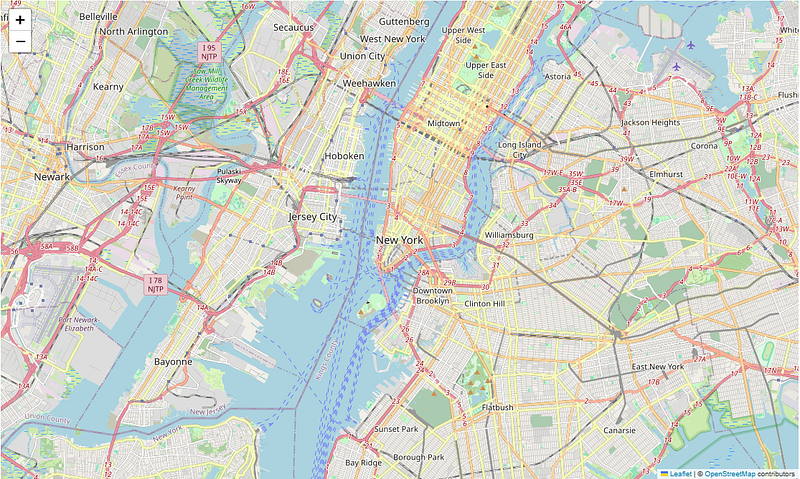
🔹 Step 2: Create a Basic Interactive Map

Open a Python script and add:

import folium

# Create a map centered on New York City
m = folium.Map(location=[40.7128, -74.0060], zoom_start=12)

# Show the map
m

# optional code
m.save("interactive_map.html")
print("Interactive map created successfully!")

Output: A basic map centered on New York City!


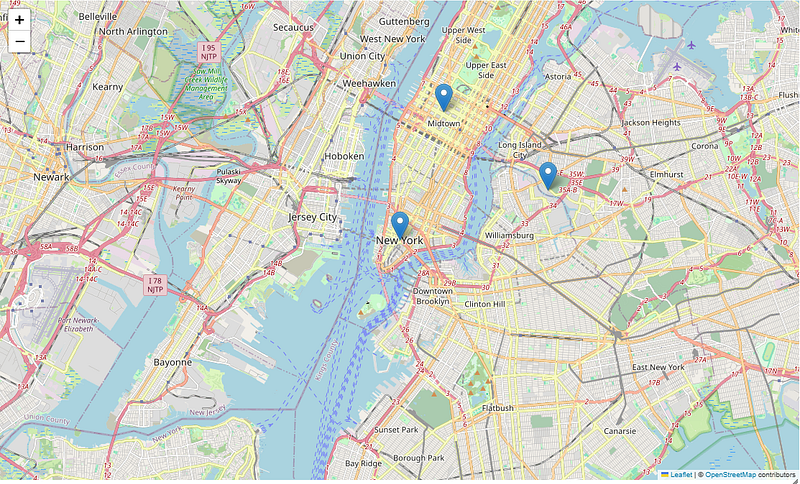
🔹 Step 3: Add Markers for Locations

Let’s add some store locations to our interactive map:

# Add store locations with popup labels
folium.Marker([40.730610, -73.935242], popup="Store A").add_to(m)
folium.Marker([40.758896, -73.985130], popup="Store B").add_to(m)
folium.Marker([40.712776, -74.005974], popup="Store C").add_to(m)

# Show the map
m

Output: Clicking on markers displays store details!


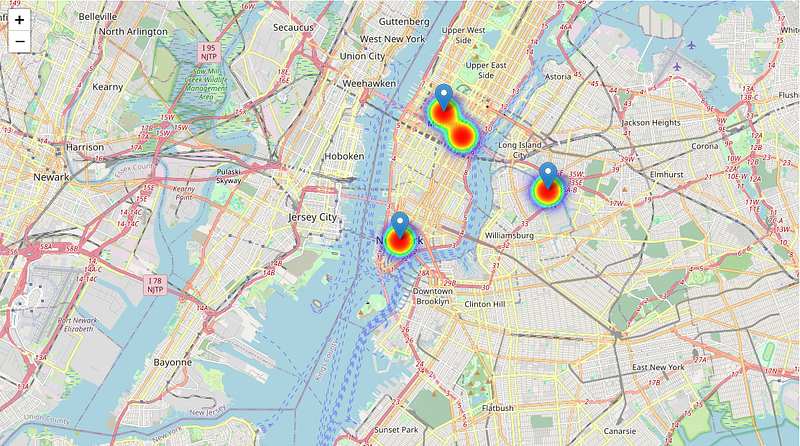
🔹 Step 4: Add a Heatmap (Optional)

If you have customer location data, you can visualize density using a heatmap.

First, install the Heatmap plugin:

pip install branca

Then, modify your Python script:

from folium.plugins import HeatMap

# Sample customer locations (latitude, longitude)
customer_data = [
[40.730610, -73.935242],
[40.758896, -73.985130],
[40.712776, -74.005974],
[40.750500, -73.976250]
]

# Add heatmap layer
HeatMap(customer_data).add_to(m)

# Show the map
m

Output: A heatmap showing customer density in different areas.


4️⃣ How to Deploy & Share Your Interactive Map

Once you’ve created your HTML map, you can:
Embed it in a website (perfect for businesses).
Share the file with team members for data insights.
Host it on GitHub Pages or a personal server.

💡 Example: A tourism website embeds an interactive map of attractions to help visitors explore a city.


5️⃣ Common Mistakes to Avoid in Interactive Mapping

Not choosing the right map projection — Can lead to distorted views.
Adding too much data at once — Can slow down performance.
Forgetting to test across devices — Make sure it works on mobile & desktop.
Ignoring user experience (UX) — Keep maps clean and simple.

💡 Example: A poorly designed map with too many layers can confuse users instead of helping them.


Conclusion: Why You Should Use Interactive Maps

Engage users with clickable locations & filters.
Improve decision-making with heatmaps & data layers.
Easily share maps without GIS software.


🔗 Useful Resources & Links

Originally published on Medium.

[GDS] Geospatial Data Science 101: How AI is Changing the Future of Geospatial Analysis


Introduction

Artificial Intelligence (AI) is transforming nearly every industry, and Geospatial Data Science is no exception. From real-time mapping to predictive analytics, AI is making GIS faster, smarter, and more powerful than ever before.

But how exactly is AI being used in geospatial analysis? And what does this mean for the future of location intelligence?

In this article, we’ll explore:
✅ The role of AI in GIS
✅ How AI improves spatial data analysis
✅ Real-world applications of AI in geospatial science
✅ The future of AI-powered GIS


1️⃣ What is AI in Geospatial Analysis?

AI in GIS refers to using machine learning (ML) and deep learning (DL) algorithms to analyze, predict, and automate geospatial tasks.

📌 AI Helps GIS By:

  • Automating manual tasks (e.g., land cover classification).
  • Detecting patterns & trends in large datasets.
  • Predicting future scenarios (e.g., traffic congestion, climate impact).
  • Processing big geospatial data faster than traditional GIS methods.

💡 Example: Instead of manually classifying satellite images, AI models can automatically detect forests, urban areas, and water bodies in seconds!


2️⃣ How AI is Enhancing GIS Analysis

🔹 1. Deep Learning for Image Classification

AI can analyze satellite images and drone footage to identify objects and changes over time.

📊 Best for:

  • Detecting deforestation and land-use change
  • Identifying vehicles, buildings, and infrastructure
  • Analyzing natural disasters (floods, wildfires, hurricanes)

💡 Example: NASA uses AI-powered image classification to track global urban expansion and deforestation trends.


🔹 2. AI-Powered Predictive Modeling

AI can predict future spatial patterns based on historical geospatial data.

📊 Best for:

  • Predicting traffic congestion in smart cities
  • Forecasting real estate price trends
  • Modeling climate change impact

💡 Example: Uber and Google Maps use AI-powered GIS models to predict travel times and optimize routes in real time.


🔹 3. Automated Feature Extraction

AI can automatically identify roads, rivers, and buildings from aerial and satellite images.

📊 Best for:

  • Updating digital maps (Google Maps, OpenStreetMap)
  • Extracting infrastructure features for urban planning
  • Monitoring construction growth from satellite imagery

💡 Example: AI helps disaster response teams quickly map damaged roads and bridges after an earthquake.


🔹 4. AI for Object Detection in GIS

Using computer vision, AI can recognize cars, ships, trees, and other objects in imagery.

📊 Best for:

  • Tracking illegal fishing vessels
  • Monitoring wildlife populations
  • Counting cars in parking lots for retail analytics

💡 Example: AI-powered drones track deforestation and illegal mining activity in the Amazon rainforest.


🔹 5. Real-Time GIS & AI for Smart Cities

AI + GIS enables real-time geospatial analytics, helping cities manage:
Traffic & transportation
Public safety (crime detection, emergency response)
Urban planning & zoning

💡 Example: AI-powered GIS helps predict & prevent traffic jams in smart cities like Singapore and Dubai.


3️⃣ How AI Works in GIS: Tools & Techniques

AI-powered GIS uses several Python libraries and tools:

ArcGIS Deep Learning Tools — Built-in AI models for spatial analysis.
Google Earth Engine — AI-powered satellite image processing.
TensorFlow & PyTorch — AI frameworks for geospatial deep learning.
Scikit-learn & XGBoost — Machine learning for predictive modeling.
OpenCV — Computer vision for image classification.

🔹 Example: AI-Powered Land Cover Classification in Python

import tensorflow as tf
import rasterio
import numpy as np

# Load satellite image
with rasterio.open("satellite_image.tif") as src:
img = src.read()

# Load AI model for land cover classification
model = tf.keras.models.load_model("landcover_model.h5")

# Predict land cover types
predictions = model.predict(np.expand_dims(img, axis=0))
print("AI-powered land cover classification completed!")

Automatically classifies land into forests, urban areas, and water bodies!


4️⃣ The Future of AI-Powered GIS

🚀 AI is making GIS:
More automated — Reducing human effort in geospatial analysis.
More predictive — Anticipating future trends & disasters.
More real-time — Live location tracking & decision-making.

📌 Emerging Trends in AI + GIS:

  • AI-generated 3D maps for urban planning.
  • Autonomous GIS mapping drones for real-time surveillance.
  • GeoAI-powered Chatbots for interactive location intelligence.

💡 Example: Future AI models may automatically update global maps in real time using satellite feeds.


Conclusion: AI is Revolutionizing GIS

AI is reshaping the way we analyze geospatial data, making GIS smarter, faster, and more insightful.

✅ AI helps classify satellite images faster.
✅ AI predicts spatial trends with high accuracy.
✅ AI automates data processing and feature extraction.


🔗 Useful Resources & Links

Originally published on Medium.