[AEE] Episode 2511 – Got a Boatload of Work? How to Share in English

✅ Highlighted Expressions & Idioms with Examples

  1. A slew of [something]
    Definition: A large number or amount, typically referring to tasks, responsibilities, or non-tangible items.
    Example: “I had a slew of emails to respond to before lunch.”
  2. A boatload of [something]
    Definition: An informal way to express a very large amount; slightly more playful than “slew.”
    Example: “She brought a boatload of snacks for the road trip.”
  3. Oodles of [something]
    Definition: A whimsical, informal way to say “a lot of”; often used with physical items or things we collect.
    Example: “He has oodles of vintage records in his basement.”
  4. A mountain of [responsibilities/tasks/etc.]
    Definition: Used to convey emotional weight or overwhelming volume, especially of abstract burdens.
    Example: “I’m under a mountain of deadlines this week.”
  5. A stack of [something]
    Definition: Often literal, refers to a tall pile, usually of papers or work.
    Example: “There’s a stack of paperwork waiting for my review.”
  6. Onslaught
    Definition: A strong or sudden rush of something, often used with work or information.
    Example: “After the product launch, we experienced an onslaught of customer feedback.”
  7. Topsy-turvy
    Definition: Describes a chaotic or disorganized situation.
    Example: “The whole move left our lives completely topsy-turvy.”

🎭 Role Play Script

Context: Two coworkers catching up in the break room on a Friday afternoon.

Jenna:
Ugh, just when I thought I could clock out early, a slew of reports landed in my inbox.

Darren:
Tell me about it. I had a boatload of emails to return this morning before I even grabbed coffee.

Jenna:
It’s like our manager waits until Friday to dump a mountain of last-minute tasks on us.

Darren:
Exactly! My desk looks ridiculous — there’s literally a stack of documents I still need to scan.

Jenna:
Honestly, this whole week has felt a bit topsy-turvy. Nothing went according to plan.

Darren:
Yeah, I miss those slower weeks when we actually had breathing room — now it’s just an onslaught of projects.

Jenna:
Same here. I even canceled dinner with friends. I’ve got oodles of little things to wrap up before the weekend.


🧩 Integrated Paragraph Using All Expressions

This week has been downright topsy-turvy. On Monday alone, I was hit with an onslaught of tasks that set the tone for the rest of the week. By Wednesday, my desk had accumulated a stack of paperwork, and emails kept pouring in — a never-ending slew of requests. Just when I thought I had a handle on things, a mountain of responsibilities landed on me ahead of Friday’s deadline. Now, with a boatload of issues still pending and oodles of minor follow-ups, I’m hoping I can catch my breath by Sunday.

✅ Expression Review in Q&A Format


Q1. What does “handy” mean in context?
A1. “Handy” means useful or convenient. In the phrase “then it’s very handy,” the speaker is saying that the expression or phrase is helpful and appropriate for the situation. It often describes tools, resources, or even expressions that are easily applicable or accessible.


Q2. What does “downright” mean?
A2. “Downright” is an intensifier that means completely or absolutely. It is often used before strong adjectives, especially to emphasize negativity or extremity, such as “downright rude” or “downright exhausting.” It can also be used for positive emphasis, though less often.


Q3. What does “set the tone for the rest of the week” mean?
A3. This means something early in the week (usually Monday) influenced the mood, pace, or energy of the following days. For example, if Monday is stressful, it can “set the tone” for a stressful week.


Q4. Does “I had a handle on things” mean the same as “I handled that”?
A4. Not quite.

  • “I had a handle on things” means you were managing everything well, usually over a period of time. It suggests control over a broader situation.
  • “I handled that” means you dealt with a specific task or issue and completed it. It’s more task-focused and final.

Q5. Can the expressions “a slew of,” “a boatload of,” “oodles of,” “a mountain of,” and “a stack of” be used with both countable and uncountable nouns?
A5. Here’s the breakdown:

ExpressionCountableUncountableNotes
A slew ofYesNoUsually used with plural countable nouns (e.g. problems, emails)
A boatload ofYesYesFlexible, informal, works with many types of nouns
Oodles ofYesYesInformal and playful, mostly used with plural countables or mass nouns like money
A mountain ofYesYesOften used with abstract or emotional concepts (e.g. stress, worries)
A stack ofYesNoTypically used for physical items you can pile up (e.g. books, papers)

Q6. What does the phrase “emails kept pouring in” mean?
A6. It means emails continued arriving rapidly or in large amounts, usually making it difficult to keep up. It’s commonly used to describe a sense of overwhelm during busy times.


Q7. What’s the difference between “I had a handle on things” and “I handled that”?
A7.

  • “I had a handle on things” refers to ongoing control over a situation. It shows that you were managing everything well.
  • “I handled that” means you took care of one specific issue or task in the past. It suggests completion rather than ongoing management.

[ABAD] The Secret Power of Small Challenges: How Little Wins Keep You Moving

We often wait for motivation to appear, like a sudden spark that makes everything easy.
But motivation is not something you find. It is something you build, one small challenge at a time.

Psychologists and authors such as Mihaly Csikszentmihalyi, Daniel Pink, Richard Ryan & Edward Deci, and recent neuroscience studies all point to the same truth:

The human brain loves progress, not perfection.


1. The Sweet Spot Between Easy and Impossible

Think about a video game.
If it is too easy, you get bored.
If it is too hard, you give up.
But when it is just challenging enough — something you almost can do — you keep playing.

That balance is what Csikszentmihalyi called the Flow Channel in his book Flow: The Psychology of Optimal Experience.
It is where your skills and the challenge meet in just the right proportion.
Too little challenge creates boredom, too much causes anxiety, but the right amount keeps you focused and curious.

This is incremental challenge — the idea of taking on something slightly harder than before.
It is not about pushing to extremes, but about stretching just a little beyond comfort.
That is where growth and motivation begin.


2. Why Small Wins Feel So Good

Neuroscience shows that every small step forward releases dopamine, the brain’s natural reward signal.
It is not given for success, but for progress itself.
That feeling of “I am getting somewhere” is what keeps you going.

Stefano Di Domenico’s study The Emerging Neuroscience of Intrinsic Motivation explains that small, manageable goals activate motivation circuits in the brain, while overly difficult tasks can shut them down.
This is why you can lose track of time while painting, coding, or writing — your brain is enjoying progress, not waiting for a trophy.


3. How to Stay Motivated Without Forcing It

In Drive: The Surprising Truth About What Motivates Us, Daniel Pink describes three key elements of motivation:

  1. Autonomy – You have the freedom to choose.
  2. Mastery – You keep improving.
  3. Purpose – You know why it matters.

Incremental challenge lives in mastery.
It gives you that sense of “I am getting better.”
Each small success fuels the next one.
You do not need pressure from others; progress itself becomes your source of energy.


4. The Psychology Behind It

According to Self-Determination Theory by Richard Ryan and Edward Deci, we all share three psychological needs:

  • Autonomy (control over our choices)
  • Competence (the feeling of being capable)
  • Relatedness (connection with others)

Incremental challenges satisfy the need for competence.
They make you feel capable and growing.
Good mentors or leaders understand this — they build steps, not walls.
Every achievable challenge strengthens confidence and keeps motivation alive.


5. Growth Feels Better Than Glory

Success is reaching a goal.
Growth is becoming someone new while reaching it.

Money, status, or titles fade quickly, but growth stays with you.
Every small challenge reshapes your brain, training it to find joy in effort itself.

As Professor Cho Byuk once said, “Happiness begins when we live a life of contribution.”
And contribution begins with growth — even the smallest kind.


6. Try This in Real Life

You can build your own motivation system:

  1. Pick one meaningful goal.
  2. Break it into small, specific steps.
  3. Choose one that feels slightly hard but still possible.
  4. Celebrate every bit of progress.

After a few weeks, you will see that motivation was never missing.
It was just waiting for movement.


Final Thought

You do not need to do big things to change your life.
You only need to do slightly bigger things than yesterday.
That is how your brain learns to enjoy effort again.
Motivation is not about hype or discipline; it is about small, steady growth — and the quiet confidence that says, I can do this, and I can do a little more.


References

  • Csikszentmihalyi, M. (1990). Flow: The Psychology of Optimal Experience. Harper & Row.
  • Pink, D. H. (2009). Drive: The Surprising Truth About What Motivates Us. Riverhead Books.
  • Ryan, R. M., & Deci, E. L. (2017). Self-Determination Theory: Basic Psychological Needs in Motivation, Development, and Wellness. Guilford Press.
  • Di Domenico, S. I., & Ryan, R. M. (2017). The Emerging Neuroscience of Intrinsic Motivation. Frontiers in Human Neuroscience, 11, 145.

[ABAD: Switch On Your Brain] You Can Change Your Brain: The 21-Day Detox Plan to Rewire Your Mind

“You are not a victim of your biology. You are a product of your choices.”
— Dr. Caroline Leaf

Every second, you are thinking. Even when you’re asleep, your mind is processing information and sorting through memories. According to cognitive neuroscientist Dr. Caroline Leaf, you cannot go more than three seconds without thinking. This isn’t just a fun fact about brain activity. It’s a powerful spiritual and scientific truth: your thoughts shape your life.

In her groundbreaking book, Switch On Your Brain, Dr. Leaf offers a hopeful and deeply practical message. Your mind is not hardwired. Your brain is not fixed. You can change the way your brain functions by changing the way you think, one thought at a time.


The Brain is Not the Mind

Dr. Leaf draws a clear line between your brain and your mind. The brain is the physical organ inside your skull. The mind, however, is your consciousness—your ability to think, feel, and choose. Your mind uses the brain, like software uses hardware, to express itself in physical form.

When you think a thought repeatedly, it becomes physically embedded in your brain as a tree-like structure made of proteins. These structures are measurable and real. According to Dr. Leaf, this is where science begins to validate spiritual principles like “renewing the mind” (Romans 12:2).

Healthy thoughts form stable, balanced “trees.” Toxic thoughts—filled with shame, fear, bitterness, or hopelessness—create distorted, unhealthy trees that damage your brain over time. Dr. Leaf calls these Toxic Thought Trees.


Toxic Thoughts Damage the Brain

Negative thinking does more than dampen your mood. It has a measurable biological impact. Toxic thoughts increase stress hormones, weaken immune response, and contribute to inflammation throughout the body. Left unchecked, they reshape the architecture of your brain.

But here’s the good news. Just as your mind can create damage, it can also repair it.


The 21-Day Brain Detox: A Proven Mental Reboot

Dr. Leaf developed a five-step daily process that helps you identify and uproot toxic thoughts, then rewire your brain with healthy, truth-aligned thinking. This method is based on both neuroscience and biblical principles. It only takes around 10 to 15 minutes a day.

The Five Steps:

1. Gather
Become aware of your thoughts. Notice what you’re thinking and how you’re feeling. Recognize physical reactions or patterns.

2. Reflect
Ask yourself why you’re thinking this way. Where did this belief come from? What memory or trigger is attached?

3. Write
Journal freely without filtering. Writing helps externalize what’s going on internally so you can process it more objectively.

4. Revisit
Review what you’ve written and evaluate it through the lens of truth. Replace lies or toxic beliefs with healthy, constructive alternatives.

5. Active Reach
Create a short, empowering statement based on your new thought. Repeat it throughout the day to reinforce the change.

This process continues for 21 days, which is the time required to break down an existing toxic thought and build a healthy replacement. To make it a true habit, however, Dr. Leaf recommends practicing the new thought for another 42 days, for a total of 63 days.


Why This Works: The Science and the Spirit

This process works because it aligns with how the brain naturally functions. Neuroscience has proven that the brain is neuroplastic—it changes in response to focused attention and experience. Every time you choose a new thought, your brain rewires itself slightly.

Quantum physics also supports this idea. In simple terms, observation affects outcome. Conscious thought can collapse a wave of possibility into a reality. What you focus on literally becomes physical matter in your brain.

Dr. Leaf suggests that this is where science is catching up with the Bible. Scriptures like Proverbs 23:7—“As a man thinks in his heart, so is he”—are not metaphorical. They are deeply biological and neurological realities.


A Practical Tool: The 21-Day Detox Planner

To help people follow this process with clarity and structure, I’ve developed a one-page 21-Day Brain Detox Tracker inspired by Dr. Leaf’s method. It includes:

  • Daily five-step checklist
  • Space to record the toxic thought, root cause, and new truth
  • Daily affirmations and progress tracker
  • Reflection prompts to assess growth

This tool allows you to track your mental renewal over 21 days and can be repeated as often as needed.

(Stay tuned—I will release a printable PDF version soon for anyone who wants to join this journey.)


Final Thoughts

You are not stuck with the brain you have today. You are not bound by the thoughts that dominated your past. Every moment is an opportunity to choose life over death, hope over fear, and truth over lies.

Your mind is a gift. Steward it well.
Your thoughts are seeds. Plant wisely.
Your brain will grow whatever you feed it.

Start today—one thought at a time.


Resources:

  • Switch On Your Brain by Dr. Caroline Leaf
  • DrLeaf.com
  • Related book: Cleaning Up Your Mental Mess (for deeper application)

Coming soon:
🧠 Printable 21-Day Brain Detox PDF Planner
💬 Daily journal templates for tracking your thought transformation
📩 Sign up to get notified

[AEE] How to Connect Over a Twist in a Movie

🔑 Key Daily Expressions and Idioms

Here are the refined, natural expressions from the script, perfect for enhancing conversational fluency and connection when discussing entertainment like movies and shows:


1. Keep you guessing

Meaning: To maintain suspense and make you unsure of what will happen next.
Examples:

  • This crime series really kept me guessing until the very end.
  • The plot twists kept me guessing the entire time.

2. Keep you on your toes

Meaning: To keep you alert or constantly paying attention.
Examples:

  • Parenting definitely keeps you on your toes.
  • That show is full of surprises. It keeps me on my toes.

3. A twist

Meaning: An unexpected development in a story.
Examples:

  • There was a huge twist in the last episode. I didn’t see it coming.
  • I love stories with a good twist—they make the whole experience more engaging.

4. I didn’t see it coming

Meaning: The outcome was completely unexpected.
Examples:

  • When the villain turned out to be the hero’s brother, I didn’t see it coming.
  • The ending totally surprised me—I didn’t see it coming at all.

5. Leave you in suspense

Meaning: To make you wait anxiously to know what happens next.
Examples:

  • Every episode ends in a way that leaves you in suspense.
  • The book leaves you in suspense after every chapter.

6. Cliffhanger

Meaning: A dramatic ending that leaves the outcome unresolved, usually prompting you to come back for more.
Examples:

  • They ended the season with a cliffhanger—I can’t wait for the next one.
  • That show is full of cliffhangers, which makes it so addictive.

🎭 Role Play Scene

Scenario: Two friends catching up after watching a suspenseful movie.

A: Hey! So, how was the movie you saw last night?
B: Oh, it was amazing. It kept me on my toes the whole time.
A: Nice! Were there any twists?
B: Huge one. I didn’t see it coming at all. The plot really kept me guessing.
A: Sounds like something that would leave me in suspense.
B: Definitely. Every scene built up to something unexpected.


📝 Example Paragraph Using All Expressions

Last night, I watched a thriller that absolutely kept me guessing from start to finish. Just when I thought I had figured it out, there was a twist that completely changed everything—I didn’t see it coming at all. The pacing was tight, and it kept me on my toes the whole time. By the end, the story left me in suspense, and of course, they wrapped it up with a major cliffhanger. Now I’m counting the days until the next season drops.

🎤 Q&A: After Reading That, You Might Be Wondering…

1. Q: “Until the very end” sounds dramatic. Is it just a fancier way of saying “until the end”?
A: Pretty much, but that little word “very” adds a strong emphasis. It highlights that something continued all the way to the final moment. If you say “until the very end,” you’re not just talking about time passing. You’re stressing that whatever was happening, it never let up for even a second.


2. Q: In the sentence “The plot twists kept me guessing the entire time,” is “the entire time” what I was guessing?
A: No. You’re not guessing the time itself. “The entire time” tells us how long you were in a state of guessing. The object of “kept” is “me,” and “guessing” is the state you’re being kept in. So it means you kept trying to figure things out from beginning to end.


3. Q: But wait, can I say “guess the entire time” if I’m literally trying to figure out how long something will take?
A: Yes, in that case, “the entire time” becomes the object of “guess.” For example, “Can you guess the entire time it’ll take to finish the project?” Here, you’re estimating the total duration. The meaning is different, and it’s perfectly correct.


4. Q: “Cliffhanger” sounds like someone is about to fall off a mountain. Where did that word come from?
A: It actually comes from that exact idea. In the 1800s, serialized novels and early films would end with the hero literally hanging off a cliff. The story would pause right there, making readers or viewers wait until the next installment to find out what happened. That’s how it became a metaphor for any story that ends at a high-tension moment.


5. Q: What’s the deal with “suspense”? How is it different from just being nervous or tense?
A: Suspense is a specific kind of tension. It comes from not knowing what’s going to happen next and caring about the outcome. It’s what keeps you watching, reading, or listening. It’s not just nervous energy, it’s controlled uncertainty that pulls you forward.withholding just enough detail, and pacing are all part of the suspense toolkit — whether in books or at brunch.


[AEE] Episode 2505 – Take the Social Pressure Off with a Theme Night in English

Here’s a complete breakdown of the refined daily expressions, role play scripts, and a paragraph incorporating all expressions from the episode “Take the Social Pressure Off with a Theme Night” by All Ears English.


1. Daily Expressions & Idioms from the Episode

These expressions are useful for casual invitations, forming social connections, and navigating early-stage friendships with tact and clarity:

🗣 “Take the pressure off”

➡️ Meaning: To relieve someone from stress or expectations.
Example: Having a theme night really takes the pressure off when inviting new friends over.


🗣 “Cooped up”

➡️ Meaning: Feeling confined or trapped indoors.
Example: I hate being cooped up all day; that’s why I love outdoor gatherings.


🗣 “Break the ice”

➡️ Meaning: To initiate conversation or interaction in a social setting to reduce tension.
Example: Cooking together was a great way to break the ice with our new neighbors.


🗣 “Blend your bubbles”

➡️ Meaning: To bring together different social groups (e.g., work friends, school friends).
Example: Hosting a wine and cheese night is a great way to blend your bubbles.


🗣 “There’s a spark” (friendship spark)

➡️ Meaning: There’s potential for a deeper connection or relationship.
Example: We met at a community event and felt a bit of a friendship spark.


🗣 “Take it to the next level” (social context)

➡️ Meaning: To deepen or advance a relationship.
Example: We’d been chatting at work for months, but starting a book club really took our friendship to the next level.


🗣 “Be specific”

➡️ Meaning: Provide clear and detailed information (especially in invitations).
Example: Be specific when inviting someone—say what you’re doing and when.


🗣 “I’ve been meaning to ask…”

➡️ Meaning: A polite way to bring up something you’ve wanted to talk about.
Example: I’ve been meaning to ask—would you be interested in joining a potluck next weekend?


🗣 “Theme night” / “[Noun] night” construction

➡️ Meaning: A night focused on a specific theme or activity (e.g., game night, pizza night).
Example: We’re having a movie night on Friday—want to join?


🗣 “Automatic conversation starter”

➡️ Meaning: A topic or element that naturally prompts discussion.
Example: Cooking together is an automatic conversation starter.


🎭 2. Role Play Scripts

🎙️ Role Play: Work Friends Inviting Each Other Over

A: Hey, Lindsay.
B: Hi!
A: Would you be interested in coming over tomorrow for pizza making night? My friends and I love to try new pizza recipes.
B: Oh wow, that sounds delicious! Sure. Also, I’ve been meaning to ask you—I’m thinking about starting a book club. Are you interested?
A: Yes! That sounds awesome.

🔹 This is a natural exchange showing how to initiate casual social plans without pressure.


🧩 3. Integrated Paragraph Using All Expressions

Last weekend, I finally decided to take the pressure off and invited a few colleagues over for a pizza making night. I’ve been feeling a bit cooped up since the weather turned cold, so it felt great to be social again. Cooking together really helped break the ice, and I realized there was a bit of a spark with some of them—we might even take it to the next level and start a book club. One of them said, “I’ve been meaning to ask if you do potlucks—we should plan one soon!” What surprised me most was how well the group clicked; I guess blending your bubbles really works when you add a structure like a theme. It was fun, relaxed, and the pizzas became an automatic conversation starter—especially the debate over pineapple toppings!

4. Language Curiosity: My Questions and What I Learned

Q1: Can you really say “pizza making night”? It feels odd to describe a night that way.

A: Yes! It’s completely natural in English to use “[noun/verb-ing] + night” constructions to name themed gatherings.

👉 In “pizza making night,” the phrase “pizza making” acts like an adjective, describing what kind of night it is.
This is a common and flexible structure, especially in casual conversation.

🧠 Formula to remember:

[activity in -ing form] + night/day/event
= A night focused on that activity.

✅ Examples:

  • wine tasting night
  • cookie baking day
  • team building event
  • pumpkin carving night

Once you recognize this pattern, you can easily create your own theme nights!


Q2: What exactly does “cooped up” mean? Where does that come from?

A: “Cooped up” is an idiom that comes from the idea of a chicken in a coop (a small cage)—trapped and unable to move freely.
When someone says they feel “cooped up,” it means they feel confined indoors, often for too long, and want to get out.

✅ Example:

I’ve been cooped up in my apartment all week. I need some fresh air!

It’s especially common when talking about working from home, bad weather, or winter months.


Q3: In “blend your bubbles,” what does “bubble” actually mean?

A: Great question! In this context, “bubble” refers to a social group—like work friends, family friends, or school parents.

➡️ “Blending your bubbles” means inviting people from different parts of your life to the same event and encouraging them to mix.
This term became especially popular during the pandemic but is now used more generally to talk about combining social circles.

✅ Example:

We’re hosting a wine night to blend our bubbles—coworkers, neighbors, and yoga friends.


Q4: Why is it “What surprised me most,” not “the most”?

A: In this sentence, “most” is functioning as an adverb, meaning “to the greatest degree.”
When “most” is used this way (after a verb like surprise, impress, matter), it’s completely fine—and even more natural—to drop “the.”

✅ Examples:

  • What matters most is honesty.
  • What helped me most was your support.
  • What impressed me most was her confidence.

👉 “The most” isn’t wrong, but “most” alone sounds more conversational and is frequently used by native speakers.


Q5: Why do we say “an automatic conversation starter”? Is “starter” countable?

A: Yes, “starter” is a countable noun, which is why we use the article “an” in front of it.

🧠 A quick tip for identifying countable nouns:

  • You can use “a/an”, make plurals (add -s), and use them with “many.”

✅ For example:

  • a conversation starter
  • two conversation starters
  • many icebreakers

So:

“An automatic conversation starter” = One specific thing that helps begin a conversation.

Other common countable nouns like this include: tip, suggestion, question, idea, tool.

[AEE] Episode 2509 – Happened To or Happened For?

This episode from All Ears English does a great job highlighting the nuanced difference between “happen to” and “happen for”—two everyday expressions that carry very different tones depending on usage. Let’s break it down into your requested format:

Refined Daily Expressions & Idioms from the Script

Here are the most useful expressions and idioms that elevate conversational skills and help you speak with nuance, especially for long-term U.S. residents.


1. Happen to (someone/something)

Meaning: Something occurred unexpectedly, often out of your control.
Tone: Neutral or negative; the person is often affected passively.
Example:

  • “What happened to your car?”
  • “It happened to us while we were parked—someone sideswiped the car.”
  • “If anything happens to me, call my mom.”

Usage tip: Often used when describing accidents, surprises, or unexpected incidents.


2. Happen to (verb)

Meaning: Something occurred by chance or coincidence.
Tone: Neutral or light; indicates coincidence or randomness.
Example:

  • “I happened to see your sister at the farmers market.”
  • “If you ever happen to be in the area, stop by.”

Usage tip: Use this to politely suggest, or describe a chance encounter. It softens the sentence.


3. Happen for (someone)

Meaning: Something good occurred in someone’s favor, often implying it was meant to be or the result of effort.
Tone: Positive, intentional, often reflects benefit or purpose.
Example:

  • “I’m really happy this happened for her—she’s been needing a fresh start.”
  • “Everything seemed to happen for me at once—I got a new job and met amazing people.”

Usage tip: Great for encouraging or validating someone’s progress or life events.


4. Everything happens for a reason

Meaning: A popular saying implying that events—especially difficult ones—have a greater purpose.
Tone: Philosophical, but can come across as dismissive in sensitive situations.
Example:

  • “Well, maybe it didn’t work out because something better is coming—everything happens for a reason.”

Usage tip: Be cautious with this; use it only if the person you’re talking to shares a similar outlook or welcomes comfort in that form.


5. Play devil’s advocate

Meaning: To present an opposing or alternative viewpoint for the sake of argument or deeper thought.
Example:

  • “Just to play devil’s advocate, couldn’t we say good things happen to those who wait too?”

Usage tip: This expression helps you soften disagreement or introduce a counterpoint diplomatically.


🎭 Role Play Script from the Episode

Context: Two friends chatting while waiting for a gym class to start.


Friend 1:
Hey, what happened to your phone? The screen looks cracked.

Friend 2:
I dropped it yesterday. Luckily, it had a screen protector, so the actual screen didn’t crack.

Friend 1:
Oh, well that’s good. By the way, I happened to see your sister at the farmers market this morning. She said she’s moving to Seattle.

Friend 2:
Yes, I’m super bummed she’s moving. She just accepted a job there.

Friend 1:
Oh, that’s so far. I know you two are really close. You’ll have to go visit.

Friend 2:
I for sure will. I love Seattle, and I’m really happy this happened for her. She’s been looking for a fresh start.


🧾 Sample Paragraph Using All Expressions

Last weekend, something crazy happened to me—I was parked at the farmers market when someone sideswiped my car and drove off! But on the bright side, I happened to run into my old college friend there, which totally lifted my mood. We chatted for a while, and she told me she finally got her dream job in New York. Honestly, I’m thrilled this happened for her; she’s been working so hard to make that move happen. Later that evening, another friend said, “Well, you know, everything happens for a reason,” but I wasn’t sure how to take it—to play devil’s advocate, sometimes bad stuff is just random. Still, it got me thinking.

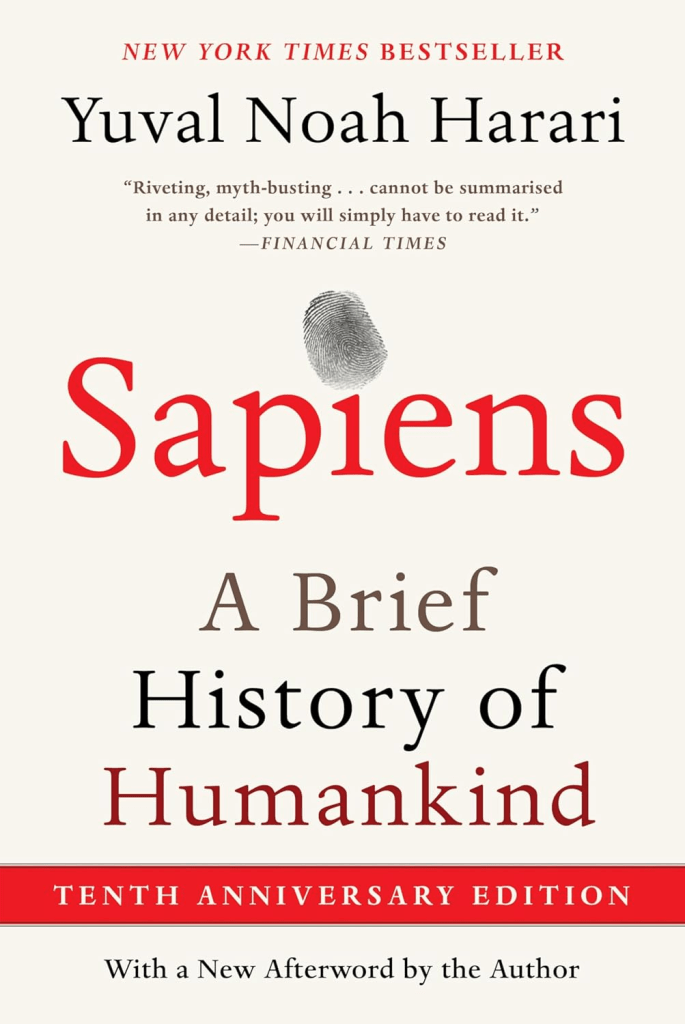
[ABAD] Sapiens – Is It Too Long? Start With These 7 Big Ideas

Let’s be honest. You’ve probably heard of Sapiens by Yuval Noah Harari, maybe even bought it, but never quite made it past chapter two. You’re not alone.

At over 400 pages of history, biology, economics, and philosophy, Sapiens is a modern classic that feels more like a marathon than a book. But what if you could get the essence of it, not a summary but the core insights, in ten minutes?

Let’s do exactly that.
Below are seven powerful takeaways from Sapiens that help explain who we are, how we got here, and why our world is built the way it is. These points go beyond summaries. They are ideas you will actually think about after you close this tab.

And if the book ever felt too long or too dense, this is where to start.


1. Humans dominate the Earth not because we’re strong, but because we believe in fiction

Around 70,000 years ago, humans experienced what Harari calls the Cognitive Revolution. It wasn’t about walking upright or using fire. Other animals did that too. The real game-changer was the ability to imagine things that don’t exist, talk about them, and convince others to believe in them.

Think about gods, nations, human rights, companies, and money. None of these things exist in nature. Yet, we organize our entire lives around them.

This ability to create and share collective myths gave Homo sapiens an edge over every other species. We cooperate in large numbers not because we are kind, but because we believe in the same stories.

The real superpower of humans is storytelling. That is what makes mass cooperation and civilization possible.


2. The greatest leap in knowledge came when humans admitted they didn’t know everything

One of the most profound ideas in Sapiens is this.
The scientific revolution began with humility.

Up until the 1500s, most societies believed they already had all the answers. These answers were often found in holy books or ancient philosophy. When faced with something unknown, people assumed it either didn’t matter or was unknowable.

But then something changed. Scientists started saying, “We don’t know, but we want to find out.”

That small shift in mindset led to everything from Newton’s laws to space travel.
In fact, old world maps before the 16th century were completely filled in, even if parts were imaginary. Later maps began leaving blank spaces. This was an honest admission of ignorance, which sparked exploration, curiosity, and massive technological progress.

Acknowledging that we don’t know something is not a weakness. It is the beginning of real knowledge.


3. Humans didn’t become rulers of the planet by being virtuous. We disrupted the ecosystem

Why are humans at the top of the food chain? Not because we were morally superior or stronger.
We simply moved too fast.

Harari points out that when predators like lions or sharks rose to the top, it took millions of years. This gave the ecosystem time to adapt. But humans rose in just a few thousand years, which is almost overnight in evolutionary terms.

Other animals had no time to adjust.
This led to mass extinctions and ecological damage. For example, many large mammals disappeared shortly after humans reached Australia and the Americas.

Our domination is not natural. It is disruptive. We are not the top because we fit in, but because we changed the rules too quickly.


4. Human progress does not equal human happiness

This one hits hard.
Yes, we have cities, smartphones, and life-saving medicine. But are we really happier than ancient foragers who roamed the land freely, ate a diverse diet, and worked fewer hours?

Harari argues that the Agricultural Revolution, which we usually celebrate, was a mixed blessing.
It allowed population growth, but also introduced hard labor, poor diets, inequality, and disease. People settled down to grow wheat, but wheat ended up domesticating us.

The species succeeded, but the individuals may have suffered.

This idea leads to a haunting insight.
More people, more tools, more power, but not necessarily more joy.


5. Civilizations grow when people believe in the same imaginary rules

Humans didn’t build pyramids, nations, and corporations just because of tools or intelligence. We built them because we believe in shared fictions.

These shared beliefs are what Harari calls imagined orders, such as money, religion, and law. They aren’t real in the way gravity or atoms are. But they are powerful because we act as if they are real.

A dollar bill only has value because millions of people agree that it does.

Even things we cherish, such as human rights or democracy, are ideas we’ve created, believed in, and institutionalized. They are not biological facts. They are collective beliefs that structure our world.

If enough people believe in the same story, it becomes the reality we live in.


6. Capitalism works because people believe tomorrow will be better

Why would someone lend money or take out a loan to start a business? It only works if both sides believe in a common story. That story is that the future will be bigger, richer, and better.

That is the core of capitalism. It is not just about money.
It is about trust in future growth. Harari explains that modern economies are built not just on hard currency, but on credit. Credit only exists when there is belief in future returns.

This belief has driven explosive progress, but it also led to things like colonialism, slavery, and climate change. Capitalism is powerful, but not always moral.

Capitalism depends on the story that growth is endless. But what happens when that story stops making sense?


7. We live inside systems we’ve created, but we forget they’re invented

Today, we take certain values for granted.
Freedom, equality, patriotism, success. But none of these are universal truths. They are ideas we have invented, accepted, and passed down.

The most dangerous myths are the ones we forget are myths.

From ancient religions to modern nationalism, humans are storytelling animals. That is both our strength and our weakness. We can unite by the billions or divide just as easily.

History is not just what happened. It is the stories we chose to believe about what happened.


So… What’s the real message?

Let’s go back to a question many readers ask.

If civilization has advanced so much, why doesn’t it always feel better?

That is the key idea Harari wants us to wrestle with.
We have conquered nature, built empires, and explored galaxies, but still struggle with loneliness, burnout, and meaning.

Progress is not always personal.
The human species may be thriving, but the individual human is not always doing better.

That is not to say things were better in the past. But Sapiens makes us question the automatic assumption that more is always better, and that newer is always wiser.


If the book felt overwhelming, just remember this:

  • We rule the Earth because we tell stories
  • Those stories only work if people believe them
  • Belief, not truth, is the foundation of civilization

And if you never finish Sapiens, that’s okay.
Knowing these seven ideas might be even more powerful than reading all 400 pages.


Too long, too complex, too late to start reading the whole book? No problem. You just did.

[AEE] Episode 2507 – Pesky Prefixes Part 2: Inconvenient English Vocabulary

Here’s your Daily Expression breakdown from the All Ears English episode: Pesky Prefixes Part 2: Inconvenient English Vocabulary.


Refined Daily Expressions & Idioms (with Examples)

These expressions are ideal for long-term U.S. residents seeking more natural, elevated, and socially attuned English.


1. Inconvenient

Meaning: Causing difficulty or discomfort; not ideal in terms of time, location, or effort.

  • “It was inconvenient for me to attend the meeting because I had another appointment.”
  • “The store’s location is inconvenient for me—it’s all the way across town.”

Why it’s valuable: A tactful way to express something is bothersome without sounding rude.


2. Indescribable

Meaning: Too extraordinary or intense to put into words.

  • “The chocolate croissant I had was indescribable—I can’t even explain how good it was.”
  • “The feeling of landing our first client was indescribable.”

Why it’s valuable: A high-impact word to express awe or deep emotion—great for storytelling and connecting.


3. Incapable

Meaning: Not having the ability to do something.

  • “I’m incapable of lifting this couch by myself.”
  • “She was incapable of hiding her excitement.”

Why it’s valuable: Offers a more refined or dramatic way to say “can’t,” especially in emotional or physical contexts.


4. Inaccurate

Meaning: Incorrect; contains errors.

  • “The data was inaccurate, and it led to a poor decision.”
  • “Her assumption turned out to be inaccurate.”

Why it’s valuable: Useful in both personal and professional settings for politely pointing out errors.


5. Indefensible

Meaning: Impossible to justify or excuse (often morally or logically).

  • “His actions were indefensible, even his colleagues refused to support him.”
  • “The mess I made of those cannoli was completely indefensible.” (Used humorously)

Why it’s valuable: Powerful for expressing disapproval or extreme failure, with both serious and playful tones.


🎭 Role Play Script (used in the episode)

Context: Two friends are catching up over breakfast.


Lindsay:
“Hey, thanks for meeting here. I’ve been wanting to try this place, but I know it’s kind of inconvenient since it’s not near any subway stops.”

Aubrey:
“No problem. The pastries make up for it. That chocolate croissant I just had was indescribable. I can’t even put into words how good it was.”

Lindsay:
“True. Have you ever tried to make croissants? I tried once and they turned out flat and sad.”

Aubrey:
“I’m impressed you even attempted. I’m totally incapable of baking anything that fancy.”

Lindsay:
“I feel like that’s inaccurate. Remember when you made that amazing tiramisu?”

Aubrey:
“Oh yeah, that’s true. But then I tried to make cannoli, and the mess I made of them is completely indefensible.”


🧩 Integrated Paragraph Using All the Expressions

I recently hosted a brunch, and while the timing was a bit inconvenient for some of my friends, they still showed up—which I appreciated. I served these chocolate croissants from Trader Joe’s that were absolutely indescribable—seriously, everyone was speechless. I had tried making them from scratch once before, but I quickly realized I was incapable of handling that level of pastry work. A friend kindly reminded me of the tiramisu I made last year, but let’s be honest—the disaster I made of those cannoli? Totally indefensible. At least now I know my skills and expectations just weren’t aligned, and the measurements I followed were probably inaccurate to begin with.

[ABAD] Guns, Germs, and Steel – Why Guns, Germs, and Steel Still Matters — And What Most People Miss by Stopping at Page 10

“Why do white people have so much cargo?”
Yali, a New Guinean politician

This was the question that changed everything for scientist Jared Diamond. A local politician in Papua New Guinea asked him why some countries seem so rich and powerful while others are not.

Diamond could not stop thinking about it. That one question became a global best-seller, a Pulitzer Prize-winning book, and a completely new way of understanding human history. That book is Guns, Germs and Steel.

Many people start reading it and give up after a few pages. It feels like a textbook. But behind the complex language is a simple and powerful idea:

The real cause of inequality in the world is geographic luck, not intelligence, culture or race.

Let’s break it down in a way that anyone can understand. In this article, we will walk through the seven key ideas in Guns, Germs and Steel. These ideas explain why some civilizations grew rich and powerful while others struggled to survive.


1. It’s Not About Race. It’s About Environment.

One of the most dangerous and outdated beliefs in history is that people in rich countries are more intelligent or more hardworking than others.

Diamond completely rejects this idea.

He says that Europe and Asia developed faster not because of better people, but because they had better starting conditions after the last Ice Age.

Some areas had the right kinds of wild plants and animals to support farming. Others did not.

Some continents had flat land, easy travel routes and mild climates. Others were filled with deserts, jungles and extreme weather.

Over thousands of years, these small differences led to huge inequalities in technology, health, population and power.


2. Farming Was the First Big Step

Before farming, humans lived by hunting and gathering. But farming changed everything.

People could now grow their own food, store it, and stay in one place. This led to:

  • Bigger populations
  • Permanent villages and cities
  • Special jobs (like leaders, soldiers and builders)
  • Inventions like writing, math and government

But here’s the key point. Farming was not possible everywhere.

The earliest crops like wheat, barley and rice only grew wild in certain parts of the world. These plants could be domesticated, meaning humans could plant and harvest them easily.

Places like the Middle East, China and Central America had good luck. Other places, like Australia or southern Africa, did not.

So even if people were equally smart, they did not have the same tools to build civilizations.


3. Animals Made a Huge Difference

Farming plants was important, but domestic animals were even more powerful.

Animals like cows, sheep, pigs and horses helped with:

  • Plowing fields (which increased food)
  • Providing milk, meat and hides
  • Carrying goods long distances
  • Helping in war (especially horses)

But again, only a few parts of the world had animals that could be tamed.

There are very strict requirements for domestication. The animal must:

  • Eat plants (not meat)
  • Grow quickly
  • Be friendly and calm
  • Live in groups
  • Be okay with being controlled by humans

Zebras, elephants and kangaroos do not qualify. Horses, cows and goats do.

And guess what? Most of the animals that humans could tame were found in Eurasia, not in the Americas or Africa.

This gave some societies a huge head start.


4. East-West Shaped Civilization. North-South Did Not.

Another big idea in the book is about the shape of continents.

Eurasia (Europe and Asia together) stretches east to west. The Americas and Africa stretch north to south.

That matters because plants, animals and technologies spread more easily across areas with similar climates.

If you move east or west, the climate stays about the same. But if you move north or south, the temperature, rainfall and seasons change a lot.

For example, if a new crop is developed in China, it can spread west into the Middle East and then into Europe.

But a new crop from Mexico would have a hard time reaching Peru. It would have to pass through deserts, jungles, mountains and tropical zones.

That is one reason why technology spread so fast in Eurasia but stayed isolated in the Americas and Africa.


5. Germs Were the Most Deadly Weapon

When Europeans arrived in the Americas, they had steel swords and guns. But their most powerful weapon was something invisible germs.

Diseases like smallpox, measles and flu killed up to 90 percent of Native Americans. In many cases, entire tribes were wiped out before a single shot was fired.

Why was this so deadly?

Because people in the Americas had never lived with large animals. That means they had not been exposed to the kinds of diseases that came from livestock.

Europeans, on the other hand, had spent centuries living with cows, pigs and chickens. Over time, their bodies developed resistance to many deadly germs.

The germs themselves evolved too. So when Europeans arrived, they brought diseases that spread fast and killed millions, often without even realizing it.


6. Inventions Don’t Change the World Until Society Is Ready

Many people believe that when we need something, we invent it.

Diamond flips that idea around.

He says invention creates need, not the other way around.

For example:

  • Thomas Edison invented the phonograph to record office meetings, not for music.
  • Gasoline was once thrown away as useless waste during oil processing.
  • The QWERTY keyboard was designed to slow down typists. Yet we still use it today.

The point is this. A great invention does not guarantee success. What matters is whether society is willing and able to adopt it.

Some technologies are ignored or forgotten because the culture, economy or politics are not ready for them.


7. Writing Systems Changed Everything

Writing is one of the most important inventions in history. It allows humans to:

  • Record laws and taxes
  • Share stories and ideas
  • Organize large societies
  • Educate future generations

But surprisingly, only three civilizations created writing from scratch:

  • The Sumerians in the Middle East
  • The Chinese
  • The Maya in Central America

All other writing systems were borrowed or inspired by these three.

For example:

  • The Roman alphabet (which we use today) was based on older alphabets like Phoenician.
  • Korean Hangul is a unique case. It was inspired by the idea of writing, but built from new principles. Diamond calls Hangul a linguistic miracle.

He also praises Hangul for being simple, logical and easy to learn, especially for beginners.


Bonus: What About Famous Leaders Like Hitler or Columbus?

You might wonder, what about leaders like Hitler or Columbus? Didn’t they shape history?

Diamond agrees that individual people matter, but only to a point.

If Hitler had died early, maybe someone else would have taken his place. The forces of history, such as resources, technology, and political systems, would still exist.

This is why Diamond focuses on geography and systems, not just famous names.


Final Message: Geography Set the Stage. We Just Played the Roles.

Jared Diamond’s main argument can be summarized in one simple sentence:

The world is unequal not because of better people, but because of better geography.

No civilization is naturally superior. No race is born to conquer others.

The real difference comes from climate, crops, animals, and whether ideas can move easily across the land.

It may not feel exciting. It’s not the story of genius kings or dramatic battles. But it is the truth behind 13,000 years of human history.


What You Can Do Next

If you have a copy of Guns, Germs and Steel on your shelf, maybe it’s time to pick it up again.

Start with this question:

Why does the world look the way it does today?

And then read with curiosity, not guilt. You don’t have to agree with everything Diamond says. But his ideas will make you think deeper about history, fairness, and the future.


Bonus Recommendation: Watch The Revenant

Want to see some of these ideas in action?

Watch The Revenant (2015) starring Leonardo DiCaprio. It’s not just about a bear attack. The film also shows the tension between Native Americans and Europeans — including the invisible violence of disease and cultural destruction.

[AEE] Episode 2506 – Explain it to Me Like I’m Five How to Ask for a Simple Breakdown in English – Daily Expression

🔑 Refined Daily Expressions & Idioms from the Script

  1. Explain it to me like I’m five (years old)
    Meaning: Break it down in the simplest terms possible.
    Tone: Casual, humorous, and slightly self-deprecating.
    Example:
    “Can you explain quantum computing to me like I’m five?”
    “I don’t get this contract language—explain it to me like I’m five.”
  2. Give me the kindergarten version
    Meaning: Requesting a very simplified version of something.
    Example:
    “This tax stuff is over my head—just give me the kindergarten version.”
  3. Break it down for me
    Meaning: Explain something step by step.
    Example:
    “I don’t understand this process. Can you break it down for me?”
  4. Simplify this for me / Make this super simple
    Meaning: Ask someone to remove jargon and explain it clearly.
    Example:
    “The instructions are confusing—can you simplify them for me?”
  5. Dumb it down for me (use with caution)
    Meaning: Very informal way to say “explain it simply.”
    Contextual Tip: Use this about yourself only to avoid offending others.
    Example:
    “I know this sounds bad, but could you dumb it down for me? I’m totally lost.”
  6. Not in my wheelhouse
    Meaning: Not within one’s area of expertise or familiarity.
    Example:
    “I’d love to help, but finance is not really in my wheelhouse.”
  7. My eyes glazed over
    Meaning: Lost focus or interest, often due to something overly complex.
    Example:
    “He started talking about crypto mining and my eyes just glazed over.”
  8. Staring down (something)
    Meaning: Facing an upcoming event or challenge with tension or anticipation.
    Example:
    “I’m staring down three client meetings tomorrow and a presentation.”
  9. On its face
    Meaning: As something appears at first glance.
    Example:
    “The policy looks fair on its face, but it’s more complicated than that.”

🎭 Role Play Script (from the episode)

Scenario: Two friends are watching a basketball game. One is unfamiliar with the sport.

A: I’ve never really been into basketball.
B: Oh, it’s easy to understand.
A: Okay, but can you explain it to me like I’m five?
B: Sure. So, see those two baskets? Each team tries to get the ball in the other team’s basket. There are five players on each team.
A: Wait, give me the kindergarten version—what do all the positions actually do?
B: Okay. The center is usually the tallest player…
A: Hmm, okay, break it down for me.
B: Right. So, the point guard usually controls the play and…
A: Sorry, this whole thing is not in my wheelhouse at all.
B: No worries! We’ll get through it. Happens to me with football—I just stare down the TV in confusion during Thanksgiving.


🧩 Practice Paragraph Using All Expressions

Lately, I’ve been trying to understand my partner’s job in software engineering, but honestly, it’s just not in my wheelhouse. He started explaining cloud infrastructure the other night and my eyes glazed over within minutes. So I finally said, “Okay, explain it to me like I’m five—what does a server even do?” He laughed and said, “Alright, let me break it down for you.” When that didn’t help, I asked, “Can you give me the kindergarten version?” Even then, I was struggling. “Look,” I said, “I know I sound ridiculous, but can you just dumb it down for me?” Thankfully, he didn’t take it personally. With the holidays coming up, I’m also staring down yet another Thanksgiving filled with football talk, and I’m determined to finally get it. I may need someone to simplify the rules for me, because while football looks straightforward on its face, it’s really not.