Emotions are not always the truth. Sometimes, they are the brain’s first rough draft.
Feelings at 2 a.m. are strange.
They sound unusually intelligent.
And they are always very confident.
“You’re living your life wrong.”
“People will eventually leave you.”
“You’ll never recover from this.”
“You’re not as good as you thought.”
At 2 a.m., emotions speak like philosophers.
But then morning comes.
You drink a glass of water.
You see a little sunlight.
You eat something.
And suddenly, the midnight philosopher disappears.
What felt like a life crisis at night becomes one simple sentence:
“I was probably just exhausted.”
This tiny shift reveals something important.
A feeling can be intense without being true.
Sometimes, an emotion is not reality itself.
It is the brain making a quick interpretation with limited information.
Or to put it more boldly:
An emotion is not the truth. It is a hypothesis.
Emotions arrive like conclusions, but they are actually first drafts
We often treat emotions as final answers.
When we feel anxious, we assume something is truly dangerous.
When we feel ashamed, we assume we are truly flawed.
When we feel angry, we assume someone has truly attacked us.
When we feel lonely, we assume no one truly cares.
Emotions arrive with a loud, confident voice.
“This is dangerous.”
“They disrespected you.”
“You failed.”
“Run.”
But just because a voice is loud does not mean it is accurate.
Think of breaking news.
Something happens, and suddenly the screen flashes:
“Breaking.”
“Still developing.”
“More details to come.”
Breaking news matters.
But it is not the whole story.
Early reports can be wrong.
Important details may be missing.
The full picture may look very different later.
Emotions are like breaking news inside the body.
They are important signals.
But they are not final reports.
Anxiety says:
“This could be dangerous.”
But we often hear:
“This is dangerous.”
Shame says:
“I might be rejected.”
But we often hear:
“I am not good enough.”
Anger says:
“My boundary may have been crossed.”
But we often hear:
“That person is bad.”
Emotions often arrive as possibilities.
We turn them into facts too quickly.
The brain cares more about survival than truth
The brain is not as elegant as we like to imagine.
Yes, we use it to write poems, solve equations, remember love, and imagine galaxies.
But one of the brain’s oldest jobs is much simpler:
Stay alive.
Every moment, the brain is asking:
“Is this safe?”
“Should I spend energy or save it?”
“Should I move closer or step back?”
“Should I fight, freeze, or leave?”
The brain is not a museum visitor calmly observing reality.
It is more like a building manager constantly checking for fire.
That is why the brain often chooses speed over accuracy.
Imagine walking down a dark street and hearing footsteps behind you.
Maybe it is just someone walking home.
Maybe there is no danger at all.
But your brain does not wait for perfect evidence.
It says:
“Be careful.”
That kind of prediction can protect us.
The problem is that the same system also runs in office meetings, family dinners, quiet rooms, relationships, and lonely nights.
Someone’s face looks slightly cold.
The brain says:
“They don’t like me.”
Someone questions your idea.
The brain says:
“I’m not respected.”
You have one unproductive day.
The brain says:
“This is who I am.”
Your brain is not trying to ruin your life.
It is trying to protect you.
But it is fast.
It is dramatic.
And sometimes, it is wrong.
A small book that changed how I see emotions
This idea was partly inspired by Lisa Feldman Barrett’s book, Seven and a Half Lessons About the Brain.
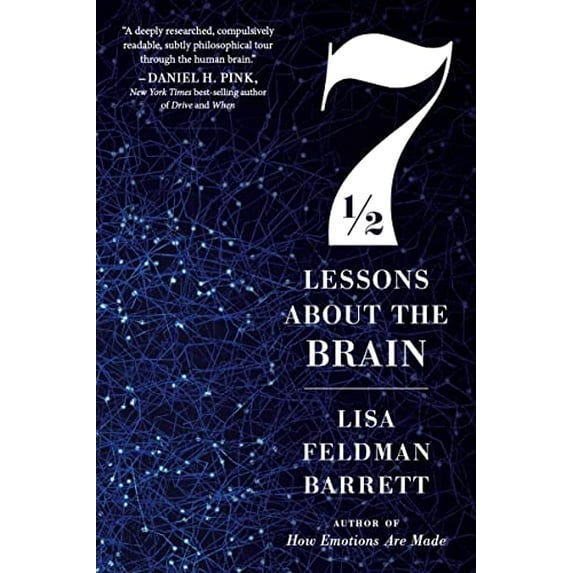
It is a short and surprisingly easy book about the brain.
But it quietly changes the way you see yourself.
Barrett does not describe the brain as a simple “thinking machine.”
Instead, she presents it as a system that manages the body, predicts the world, and helps construct our experience.
That includes emotions.
We usually think emotions are natural truths that rise from deep inside us.
But this book invites a different view:
Maybe emotions are not raw facts.
Maybe they are interpretations.
Maybe the brain uses past experience, body signals, and present clues to guess what is happening.
And that guess becomes what we feel.
After reading it, one question stays with you:
“Is this feeling a fact, or is my brain making a prediction?”
That question does not make emotions less important.
It makes them more interesting.
Emotion is the subtitle the past writes over the present
Why do two people feel completely different things in the same situation?
Because they are not only reacting to the situation.
They are reacting through their own history.
For one person, silence feels peaceful.
For another, silence feels like abandonment.
For one person, criticism feels useful.
For another, it feels like an attack on their whole identity.
For one person, failure means “try again.”
For another, it means “I knew I was never enough.”
The event may be similar.
But the emotional response is different because the brain uses different data.
The brain does not read the present alone.
It brings old experiences, repeated messages, body memories, relationship patterns, and past wounds into the room.
Then it places a subtitle over the present moment:
“This is dangerous.”
“This is rejection.”
“This proves you are not enough.”
“This is happening again.”
And we often mistake that subtitle for reality.
But it is not pure reality.
It is interpretation.
More precisely, it is the past explaining the present.
That is why some emotions are less about what just happened and more about what once happened.
Today’s anger may carry old unfairness.
Today’s anxiety may carry an old wound.
Today’s shame may carry a sentence someone said years ago.
Emotion happens now.
But it is often written in the grammar of the past.
There must be space between “I feel this” and “This is true”
One of the most important emotional skills is not getting rid of feelings.
It is creating a little space between feeling and fact.
“I feel abandoned.”
That may be honest.
But:
“I have been abandoned.”
That needs more evidence.
“I feel disrespected.”
That may matter.
But:
“They intentionally disrespected me.”
That is still under investigation.
“I feel like a failure.”
That is painful.
But:
“I am a failure.”
That is too large a sentence.
We often use emotions like verdicts.
But emotions are not verdicts.
They are witnesses.
A witness should be heard.
But we do not end the entire trial after one testimony.
When a feeling speaks, we can ask:
“What are you trying to protect me from?”
“What story are you telling?”
“What evidence do you have?”
“Could there be another explanation?”
“Is this about what is happening now, or what happened before?”
These questions do not reject emotion.
They respect it more deeply.
Because blindly believing every feeling is not the same as honoring yourself.
To truly care for yourself, you need to listen to your emotions without letting them become your only reality.
Not believing every feeling does not mean betraying yourself
There is an easy misunderstanding here.
If emotions are hypotheses, does that mean we should not trust ourselves?
No.
It means we should trust ourselves more carefully.
Imagine a child running into your room at night after a nightmare.
You would not say:
“That wasn’t real. Stop crying.”
That would be cold.
But you also would not say:
“Yes, the monster from your dream is real. We need to run.”
That would make the child even more afraid.
A wiser response would be:
“That felt really scary. I believe that you were scared. But let’s look together. There is no monster here.”
Our emotions need the same kind of response.
To anxiety, we can say:
“I hear that you’re scared. Let’s check.”
To anger:
“I hear that something felt wrong. Let’s slow down before we attack.”
To shame:
“I hear that you want to hide. But your whole existence is not a mistake.”
This is what it means to treat emotion as a hypothesis.
You do not ignore it.
You do not worship it.
You listen.
Then you look.
Emotions are not enemies. They are clumsy protectors.
Many emotions are trying to protect us.
Anxiety tries to prepare us for future danger.
Anger tries to defend our boundaries.
Shame tries to prevent social rejection.
Sadness tells us that something mattered.
Emotions are not here to destroy us.
The problem is that they are sometimes clumsy.
Anxiety turns a possibility into a catastrophe.
Anger turns a complicated person into a villain.
Shame turns a mistake into an identity.
Sadness paints one chapter as the whole book.
Emotion may be a protector.
But it is not always a wise protector.
So we can thank the emotion without handing it the steering wheel.
Emotion says:
“I’m trying to keep you safe.”
And we can answer:
“Thank you. But I’m going to look more slowly this time.”
Emotion is not a period. It is a question mark.
When a strong feeling arrives, we often end the sentence too quickly.
“I feel anxious. Therefore, I am in danger.”
“I feel angry. Therefore, you are wrong.”
“I feel ashamed. Therefore, I am worthless.”
“I feel lonely. Therefore, I am unloved.”
But emotion does not have to be the end of the sentence.
It can be the beginning of a better question.
If I feel anxious:
“What is my brain predicting?”
If I feel angry:
“What boundary feels crossed?”
If I feel ashamed:
“Whose standard am I using to judge myself?”
If I feel lonely:
“What kind of connection do I need?”
Seen this way, emotion is not an enemy.
It is an entrance.
But we should not believe the sign at the entrance when it says:
“This is the absolute truth.”
A better sign would read:
“Start investigating here.”
Everything I feel is not everything I am
Emotions can be powerful.
Sometimes they take over the whole body.
And when that happens, we can mistake the feeling for our identity.
I am anxious.
I am angry.
I am too sensitive.
I am broken.
I am the kind of person who always falls apart.
But maybe we are not the emotion itself.
Maybe we are the one noticing it.
The one who sees anxiety passing through.
The one who feels anger rising.
The one who watches sadness arrive and slowly change shape.
Emotion happens inside us.
But it is not all of us.
An emotion is a hypothesis the brain offers.
Sometimes it protects us.
Sometimes it traps us in the past.
Sometimes it comes from a tired body.
Sometimes it needs to be checked, questioned, and rewritten.
So when a feeling speaks with absolute confidence, we do not have to kneel before it.
We can say:
“I hear you.
But I am not ready to call this the truth.”
Maybe emotional freedom begins there.
Not by removing feelings,
but by no longer confusing them with reality.
To welcome every emotion,
but reread the story it tells.
That may be one of the quietest and strongest forms of kindness we can offer ourselves.
 Site Title