Reading several books at once is not always a sign of distraction. Done well, it can be a smarter way to learn.
Have you ever had three, five, or maybe even ten unfinished books lying around?
One book on your desk.
One beside your bed.
One in your bag.
One open on your Kindle.
And then the guilt appears.
“I can’t even finish one book.”
“Maybe I’m too distracted.”
“Real readers probably read one book at a time.”
But what if that guilt is based on the wrong idea?
What if reading multiple books at once is not a weakness, but a powerful way to remember more, connect ideas, and enjoy reading longer?
This is where interleaving reading comes in.
Interleaving reading means reading different books in rotation instead of finishing one book completely before starting another. You might read a psychology book in the morning, a novel at night, and a business book over the weekend.
At first, it sounds messy.
But learning science tells us something interesting: the brain often remembers better when learning is spaced out, mixed, and slightly challenging.
That is one of the big ideas in Make It Stick, a book about how real learning works.
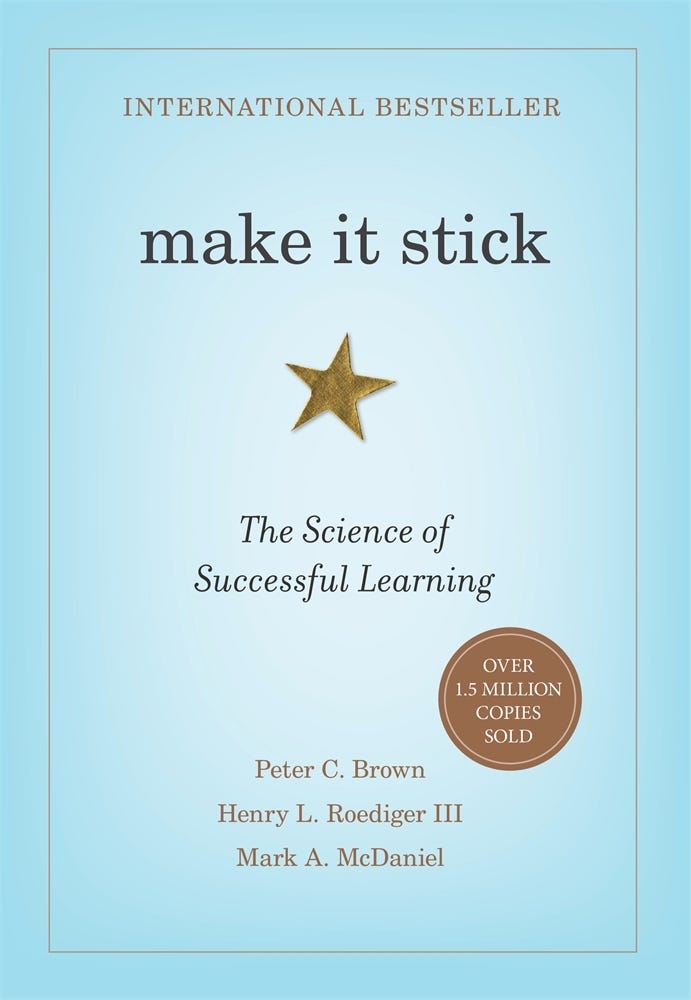
And it gives us a better way to think about reading.
Finishing a Book Feels Good, But That Is Not the Whole Point
Finishing a book feels great.
There is something satisfying about closing the final page and thinking, “I did it.”
But let’s be honest.
Have you ever finished a book and forgotten almost everything a week later?
I have.
The problem is that we often confuse finishing with learning.
Reading the last page does not always mean the book changed us. Sometimes we finish a book, add it to a list, and move on without carrying much from it.
But sometimes, one chapter changes how we think.
One sentence stays in our head for days.
One idea connects with something we read somewhere else.
That is the real value of reading.
Not just finishing.
But gaining something.
A question.
A tool.
A new way to see the world.
Interleaving reading helps because it shifts our focus from “How many books did I finish?” to “What did these books give me?”
Why Returning to a Book Makes Memory Stronger
One of the key ideas in Make It Stick is retrieval practice.
That sounds technical, but the idea is simple:
We remember better when we try to pull information out of our memory.
Not just rereading.
Not just highlighting.
Not just staring at the same page again.
Actually trying to remember.
When you return to a book after a few days, your brain naturally does this.
You ask yourself:
“What was this chapter about?”
“Where did I stop?”
“What was the author trying to say?”
“Why did I care about this idea?”
That small struggle is useful.
It wakes up your memory.
When you read one book straight through, you may not need to recall much. The previous page is still fresh. But when you come back after reading something else, your brain has to work harder.
And that effort helps the idea stick.
So the next time you return to a half-read book and feel a little lost, do not panic.
That moment is not failure.
It might be your brain doing the work that makes learning last.
Spacing Gives Ideas Time to Grow
Another idea from Make It Stick is spacing.
Spacing means learning something, taking a break, and coming back to it later.
This is why cramming often feels productive but fades quickly. When we consume too much at once, it can feel like we are learning a lot. But the memory may not last.
Reading a book in one big rush can be like eating too fast.
You finish the meal, but you barely taste it.
Interleaving reading naturally creates space.
You read a few pages of a history book.
Then you spend a day with a novel.
Then you come back to the history book later.
That gap matters.
While you are away from the book, the ideas do not always disappear. Sometimes they quietly sit in the background. Then, when you return, you see them differently.
A sentence that felt ordinary on Monday may feel important on Friday.
Why?
Because you changed.
You read something else.
You had a conversation.
You noticed something in real life.
Spacing gives ideas room to breathe.
Mixing Books Helps You Connect Ideas
This is the most exciting part of interleaving reading.
When you read different kinds of books, ideas begin to talk to each other.
Imagine you are reading a psychology book about loss aversion. It says people feel losses more strongly than gains.
Later, you read an investing book. Suddenly, you understand why people hold losing stocks for too long.
Then you read a novel. A character refuses to leave a broken relationship because they cannot accept what they have already lost.
Different books.
Different topics.
Same human pattern.
That is the magic.
A psychology book gives you a concept.
A finance book gives you a real-world example.
A novel gives you the emotion behind it.
Together, they make the idea unforgettable.
This is why good reading does not only happen inside one book.
Sometimes the best thinking happens between books.
Interleaving Reading Makes Reading Less Boring
Let’s be practical.
Some books are hard.
A philosophy book may be brilliant, but you may not want to read it for two hours straight. A science book may be fascinating, but after twenty pages, your brain may beg for mercy.
Interleaving helps you keep going.
Instead of quitting the difficult book forever, you pause and move to something lighter.
A novel.
An essay.
A short biography.
A practical book.
Then later, you return.
This is not giving up.
It is pacing yourself.
Think of it like exercise. You do not train the same muscle every hour of every day. You rotate. You recover. You come back stronger.
Reading can work the same way.
Interleaving reading helps you build a reading rhythm that lasts.
But There Are Real Downsides
Interleaving reading is powerful, but it can go wrong.
The biggest danger is using it as an excuse to avoid difficulty.
If every time a book gets hard, you immediately run to a new book, that is not interleaving. That is escape.
There is a difference between taking a useful break and avoiding deep thinking.
Another danger is opening too many books at once.
Three books can create variety.
Ten books can create noise.
When there are too many open loops, you may forget the main argument of each book. You may spend more time trying to remember where you were than actually reading.
So start small.
A good beginner setup is:
One deep book
Something like history, science, philosophy, or economics.
One practical book
Something about writing, business, investing, AI, productivity, or a skill you want to build.
One light book
A novel, essay collection, memoir, or anything that makes reading feel enjoyable.
That is enough.
You get depth, usefulness, and pleasure.
The Simple Rule: Leave a Breadcrumb
If you want interleaving reading to work, do one tiny thing.
Before closing a book, leave a note.
Just one sentence.
For example:
“The main idea today: people avoid loss more than they seek gain.”
Or:
“Question for next time: how does this idea connect to decision-making?”
Or:
“This reminds me of the character in the novel who could not let go.”
That one sentence is a breadcrumb.
When you return to the book, it helps you find your way back.
You do not need a complicated note-taking system. You do not need a perfect reading journal. You just need a small bridge between your present self and your future self.
Interleaving reading is not about opening many books.
It is about returning to them with more understanding.
Reading Is Not a Race to the Last Page
We live in a world that loves numbers.
How many books did you read this year?
How many pages per day?
How many books are on your shelf?
Numbers can motivate us. But they can also trick us.
They can make us treat reading like a race.
But reading is not only about reaching the final page.
It is about what remains after the page is turned.
A sentence that changes your thinking.
A story that makes you more compassionate.
An idea that helps you solve a problem.
A connection you would never have seen before.
That is the real reward.
Finishing a book is nice.
But getting something meaningful from a book is better.
The Books on Your Desk Might Be Talking to Each Other
So, should everyone read multiple books at once?
Not always.
Some books deserve full attention. Some novels are best read in one emotional flow. Some arguments are easier to follow when you stay with one author from beginning to end.
But we should stop thinking that reading one book at a time is the only “proper” way to read.
Interleaving reading can help us remember more because it makes us return, recall, space out, compare, and connect.
That is exactly how many ideas become stronger in the mind.
So the next time you see several unfinished books around you, do not rush to feel guilty.
Maybe you are not being distracted.
Maybe your books are having a conversation.
And maybe, somewhere between them, your best thoughts are beginning to grow.
 Site Title