Why the future may belong to people who understand AI, robots, and electricity
Imagine waking up in the year 2035.
Your coffee is made by a robot.
Your groceries arrive in a self-driving van.
Your doctor’s first diagnosis comes from AI.
Your favorite movie was partly written by software.
And somewhere far away, a giant data center is burning through electricity so your AI assistant can answer one simple question:
“What should I cook for dinner?”
Sounds funny.
But this is the strange future we are walking into.
For most of human history, we believed money was the most important asset. If you had money, you had power. You could buy land, hire workers, build factories, and control resources.
But what happens when robots can work all day?
What happens when AI can write, code, design, plan, and analyze?
What happens when factories can produce more goods with fewer people?
Then the most important question changes.
It is no longer:
“How much money do you have?”
It becomes:
“What can you produce?”
And behind all production, there is one thing everything needs.
Energy.
Money Is a Promise. Energy Is Real.
A dollar is useful because people believe in it.
The government supports it. Banks use it. Stores accept it. People trust it.
But money has one funny weakness.
It can be created.
A central bank can push more money into the system. A government can borrow more. Numbers can appear on screens.
Energy does not work like that.
You cannot print electricity.
To create energy, you need solar panels, nuclear plants, batteries, power lines, engineers, metals, land, and time.
That makes energy very different from money.
Money is a symbol.
Energy is physical.
Money moves value around.
Energy makes things happen.
AI needs energy. Robots need energy. Data centers need energy. Electric cars need energy. Automated factories need energy.
So in an AI-powered world, the real bottleneck may not be cash.
It may be electricity.
Technology Makes Things Cheaper
Here is the big idea from Jeff Booth’s book, The Price of Tomorrow:
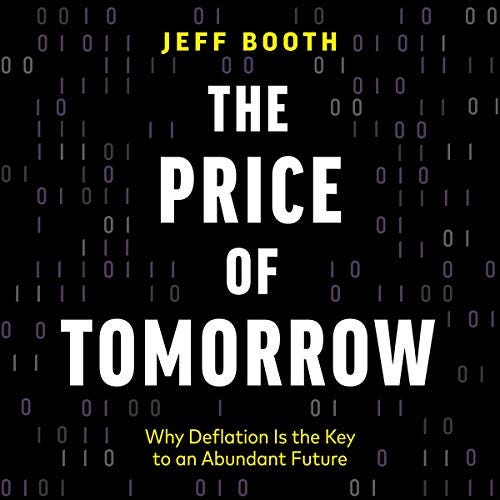
Technology naturally makes prices fall.
Think about it.
Taking photos used to cost money. You needed film. You needed printing. You had to wait.
Now your phone takes thousands of photos almost for free.
Maps used to be physical books. Now GPS is free.
Music used to come on CDs. Now millions of songs live in your pocket.
AI is doing the same thing to knowledge work.
Writing a first draft? Cheaper.
Making a design? Cheaper.
Writing basic code? Cheaper.
Summarizing documents? Cheaper.
Answering customer questions? Cheaper.
Technology pushes the cost of many things toward zero.
That is wonderful for consumers.
But it is scary for workers whose jobs are built around repeatable tasks.
Robots Do Not Replace Everyone. They Replace Repetition.
People often ask:
“Will robots take all the jobs?”
That is the wrong question.
A better question is:
“How much of my job is repeatable?”
Robots are great at repeatable physical work.
AI is great at repeatable mental work.
That means the first jobs under pressure are not always the hardest jobs or the easiest jobs.
They are the jobs with clear patterns.
Customer support scripts.
Basic legal documents.
Simple accounting.
Data entry.
Warehouse movement.
Basic coding tasks.
Routine reports.
If a job can be explained step by step, software and robots will eventually learn the steps.
But this does not mean humans become useless.
It means humans must move up the ladder.
The future belongs to people who can use AI, guide robots, solve messy problems, and build trust with other people.
The New Assets of the Future
If money becomes less powerful, what becomes more powerful?
Four things stand out.
1. Energy
Energy is the base layer of the future.
No energy, no AI.
No energy, no robots.
No energy, no data centers.
No energy, no electric economy.
Solar, nuclear, batteries, power grids, and energy storage may become some of the most important parts of the economy.
In the old world, oil powered empires.
In the new world, electricity may power intelligence.
2. AI Systems
Owning a factory used to be a huge advantage.
In the future, owning an AI system may be just as powerful.
A small team with AI can do work that once required a large company.
One person can write code, make videos, research markets, design products, and automate customer support.
That means the gap will grow between people who use AI and people who ignore it.
AI will not replace all humans.
But humans who use AI may replace humans who do not.
3. High-Quality Data
AI learns from data.
But not all data is equal.
Random internet noise is cheap.
Expert knowledge is valuable.
Clean medical data is valuable.
Legal data is valuable.
Financial data is valuable.
Real human behavior data is valuable.
In the future, data may be like oil.
But better.
Oil gets burned once.
Good data can train many systems again and again.
4. Human Trust
This one sounds old-fashioned.
But it may become the most important asset of all.
When AI can create fake images, fake voices, fake articles, fake reviews, and fake experts, people will ask one question more than ever:
“Who can I trust?”
AI can give answers.
But AI cannot truly take responsibility.
A doctor still needs trust.
A teacher still needs trust.
A leader still needs trust.
A founder still needs trust.
A friend still needs trust.
The more artificial the world becomes, the more valuable real human trust becomes.
So What Should You Do?
You do not need to become Elon Musk.
You do not need to build a robot army.
You do not need to understand every detail of nuclear energy, machine learning, or data centers.
But you should start moving in the right direction.
Use AI every day.
Not once a month. Every day.
Use it to write better emails.
Use it to learn faster.
Use it to summarize hard topics.
Use it to brainstorm business ideas.
Use it to automate boring work.
Use it to build small projects.
The goal is not to let AI think for you.
The goal is to make yourself stronger.
Next, look at your work.
Ask yourself:
“Which parts of my job are repetitive?”
Those parts are at risk.
Then ask:
“Which parts require judgment, taste, leadership, creativity, or trust?”
Those parts are where you should grow.
Do not just do the task.
Learn how to improve the system.
Do not just write the report.
Learn how to automate the report.
Do not just answer customer questions.
Learn how to design the AI assistant that answers them.
Do not just use tools.
Learn how tools change the game.
Money Will Not Disappear Overnight
Let’s be clear.
The dollar is not going to vanish tomorrow.
People will still need money. Businesses will still use money. Governments will still collect taxes. Banks will still exist.
But the meaning of money may change.
In the past, money bought human labor.
In the future, money may buy access to production systems.
Access to AI.
Access to energy.
Access to robots.
Access to data.
Access to networks of trust.
That is a very different world.
In that world, being rich is not just about having a large bank account.
It is about having control over useful systems.
The Simple Truth
The future may sound complicated, but the lesson is simple.
Money is useful.
But money alone is not enough.
The real power will belong to people who understand how things are made, how intelligence is automated, how energy flows, and how trust is built.
So maybe the question is not:
“Will money disappear?”
Maybe the better question is:
“When money becomes less important, what will I have built?”
Because in the next economy, the winners may not be the people holding the most cash.
They may be the people holding the keys to energy, AI, automation, data, and trust.
 Site Title