What Co-Intelligence teaches us about surviving and thriving with AI
AI is no longer something far away.
It is already here.
It writes.
It explains.
It summarizes.
It designs.
It codes.
It plans.
It teaches.
And because of that, many people are asking the same nervous question:
“Will AI replace me?”
But maybe that is the wrong question.
The better question is:
“Can I learn how to think, work, and grow with AI?”
That is the powerful idea behind Co-Intelligence.
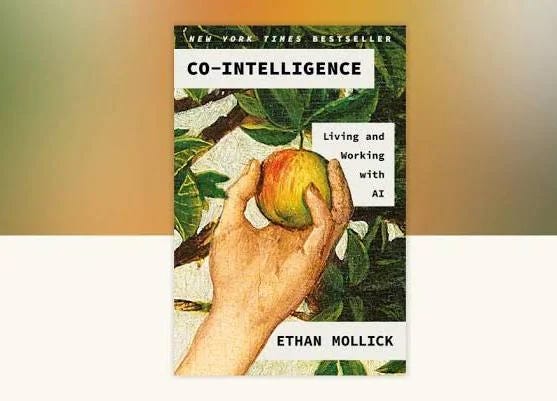
The book does not treat AI as a simple tool. It presents AI as something closer to a thinking partner. Not a human. Not a magic machine. Not something we should blindly trust.
But something we can work with.
Something we can learn from.
Something that can make us better, faster, and more creative — if we know how to use it well.
In the AI era, the people who survive will not simply be the smartest people.
They will be the best learners.
AI is not just a search engine
Most people use AI in a very simple way.
They ask it to summarize an article.
They ask it to fix a sentence.
They ask it to write an email.
They ask it to explain a topic quickly.
That is useful.
But it is only the beginning.
Using AI only this way is like buying a powerful computer and using it only as a calculator.
Co-Intelligence shows us a different way.
AI can be invited into almost every part of thinking.
You can ask it to challenge your idea.
You can ask it to explain what you do not understand.
You can ask it to create a study plan.
You can ask it to act like a coach.
You can ask it to help you see your blind spots.
The real value of AI is not just that it gives answers.
The real value is that it helps you think better.
The future belongs to people who can learn faster
In the past, learning was slow.
If you wanted to understand a difficult topic, you had to read books, search online, watch lectures, ask experts, and slowly connect the dots by yourself.
That process still matters.
But now, AI can make the first step much easier.
You can open a difficult article and ask:
“Explain this to me like I am 10 years old.”
Then you can ask:
“Now explain it at a college level.”
Then:
“What are the five key ideas I must remember?”
Then:
“Test me on this.”
Then:
“Where is my understanding weak?”
This changes everything.
AI does not remove the need to learn.
It removes many of the barriers that stop people from learning.
That means the most important skill is no longer memorizing everything.
The most important skill is knowing how to keep learning.
AI reflects the quality of your thinking
One of the most important lessons from Co-Intelligence is this:
AI often responds at the level of the person using it.
If you give it a vague question, you often get a vague answer.
If you give it better context, a clearer goal, and stronger examples, the answer improves.
For example, compare these two prompts:
“Help me write an article about AI.”
Now compare it with this:
“I want to write a 5-minute article for beginners about why AI should be treated as a learning partner, not just a tool. The tone should be simple, inspiring, and practical. Give me a strong structure with examples.”
The second prompt will almost always lead to a better result.
Why?
Because AI needs direction.
AI can move fast, but you still need to point it somewhere.
This is why the future will not belong to people who only know how to “use AI.”
It will belong to people who know how to think clearly with AI.
The human role is changing
For a long time, many jobs were built around doing tasks.
Writing reports.
Making slides.
Summarizing information.
Finding data.
Creating drafts.
Organizing documents.
AI can now help with many of these things.
So what is left for humans?
A lot.
Humans still need to define the goal.
Humans still need to judge what matters.
Humans still need to understand people.
Humans still need to decide what is ethical.
Humans still need to choose the direction.
AI can produce options.
But humans must decide which option is meaningful.
AI can give information.
But humans must decide what to do with it.
AI can help create.
But humans must bring taste, judgment, values, and purpose.
The future is not about humans disappearing.
It is about humans changing their role.
Stop asking, “What can AI do?”
Many people ask:
“What can AI do?”
That question is useful, but limited.
A better question is:
“What can I become with AI?”
That is the heart of Co-Intelligence.
AI is not only about saving time.
It is about expanding ability.
A beginner can learn faster.
A small team can create more.
A writer can test more ideas.
A student can get personal explanations.
A worker can improve weak areas.
A creator can explore new directions.
AI gives people leverage.
But leverage only matters when you use it.
A person who uses AI every day will slowly build a new kind of skill.
They will learn what AI is good at.
They will learn where AI fails.
They will learn how to ask better questions.
They will learn how to check the answers.
They will learn how to combine human judgment with machine intelligence.
That daily practice creates the real gap.
Not between people who have AI and people who do not.
But between people who practice with AI and people who avoid it.
Everyone has to become a student again
This may be the most uncomfortable truth.
In the AI era, everyone is a beginner.
Your title does not protect you.
Your degree does not protect you.
Your past success does not protect you.
Your experience matters, but it is not enough by itself.
Everyone has to learn again.
That sounds scary.
But it is also hopeful.
Because if everyone is learning again, then it is not too late to start.
You do not need to master everything today.
You only need to begin.
Ask AI to help you understand one topic.
Ask it to review one piece of your work.
Ask it to improve one idea.
Ask it to explain one difficult concept.
Ask it to show you what you are missing.
Then ask again.
That second question matters.
The people who grow with AI are not the people who ask once and stop.
They are the people who keep going.
The most important skill is learning how to learn
The AI era can feel overwhelming because everything moves so fast.
New tools appear.
New models improve.
New skills become valuable.
Old ways of working begin to change.
You cannot control all of that.
But you can control one thing:
Your ability to learn.
That is why the most important skill in the AI era is not coding.
It is not prompt engineering.
It is not automation.
Those things can help, of course.
But underneath them all is something more important:
A learner’s mindset.
A learner asks better questions.
A learner tries new tools.
A learner accepts feedback.
A learner is not ashamed of not knowing.
A learner improves through practice.
AI rewards learners.
The more curious you are, the more useful AI becomes.
The more clearly you think, the better AI responds.
The more you practice, the stronger your results become.
The real danger is not AI
The real danger is not that AI is getting smarter.
The real danger is refusing to learn.
AI will not automatically make everyone better.
Some people will use it deeply.
Some people will use it lightly.
Some people will ignore it.
Some people will fear it.
Some people will blame it.
But the people who treat AI as a learning partner will gain something powerful.
They will gain speed.
They will gain confidence.
They will gain new ideas.
They will gain a personal teacher that is available every day.
That is the promise of Co-Intelligence.
Not that AI will do everything for us.
But that AI can help us become more capable than before.
Final thought
The question is no longer:
“Can AI think?”
The better question is:
“Can I think better with AI?”
That is the shift.
AI is not just a tool for finishing tasks.
It is a partner for learning, creating, questioning, and improving.
The people who thrive in this new era will not be the people who know everything.
They will be the people who are willing to begin again.
So the message is simple:
Read Co-Intelligence.
Start using AI every day.
Ask better questions.
Stay curious.
Become a student again.
 Site Title