“Why do white people have so much cargo?”
— Yali, a New Guinean politician
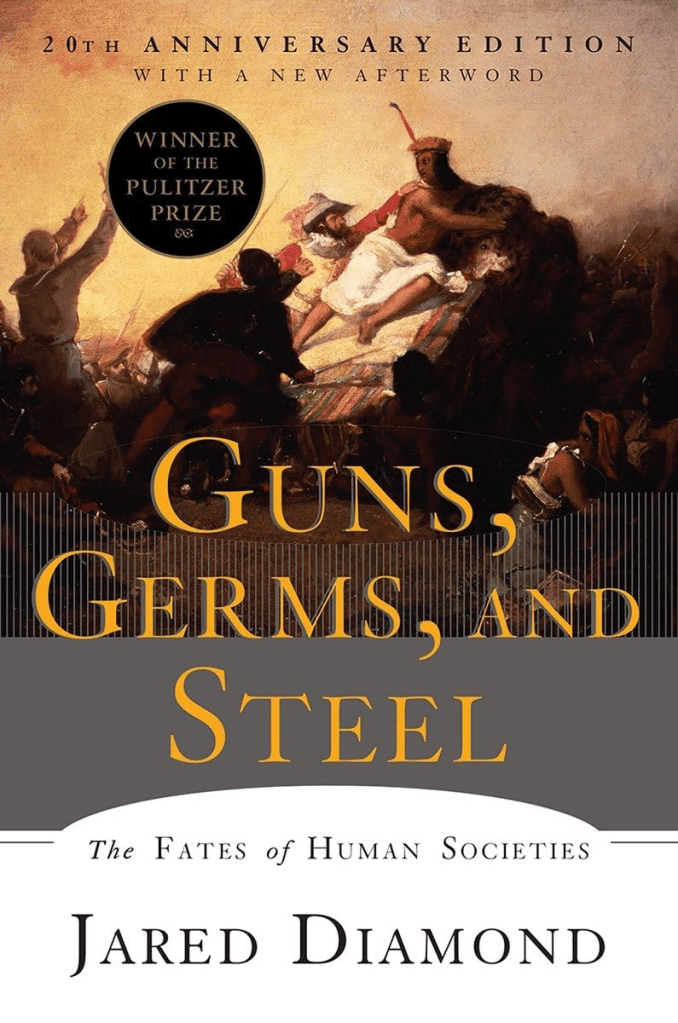
This was the question that changed everything for scientist Jared Diamond. A local politician in Papua New Guinea asked him why some countries seem so rich and powerful while others are not.
Diamond could not stop thinking about it. That one question became a global best-seller, a Pulitzer Prize-winning book, and a completely new way of understanding human history. That book is Guns, Germs and Steel.
Many people start reading it and give up after a few pages. It feels like a textbook. But behind the complex language is a simple and powerful idea:
The real cause of inequality in the world is geographic luck, not intelligence, culture or race.
Let’s break it down in a way that anyone can understand. In this article, we will walk through the seven key ideas in Guns, Germs and Steel. These ideas explain why some civilizations grew rich and powerful while others struggled to survive.
1. It’s Not About Race. It’s About Environment.
One of the most dangerous and outdated beliefs in history is that people in rich countries are more intelligent or more hardworking than others.
Diamond completely rejects this idea.
He says that Europe and Asia developed faster not because of better people, but because they had better starting conditions after the last Ice Age.
Some areas had the right kinds of wild plants and animals to support farming. Others did not.
Some continents had flat land, easy travel routes and mild climates. Others were filled with deserts, jungles and extreme weather.
Over thousands of years, these small differences led to huge inequalities in technology, health, population and power.
2. Farming Was the First Big Step
Before farming, humans lived by hunting and gathering. But farming changed everything.
People could now grow their own food, store it, and stay in one place. This led to:
- Bigger populations
- Permanent villages and cities
- Special jobs (like leaders, soldiers and builders)
- Inventions like writing, math and government
But here’s the key point. Farming was not possible everywhere.
The earliest crops like wheat, barley and rice only grew wild in certain parts of the world. These plants could be domesticated, meaning humans could plant and harvest them easily.
Places like the Middle East, China and Central America had good luck. Other places, like Australia or southern Africa, did not.
So even if people were equally smart, they did not have the same tools to build civilizations.
3. Animals Made a Huge Difference
Farming plants was important, but domestic animals were even more powerful.
Animals like cows, sheep, pigs and horses helped with:
- Plowing fields (which increased food)
- Providing milk, meat and hides
- Carrying goods long distances
- Helping in war (especially horses)
But again, only a few parts of the world had animals that could be tamed.
There are very strict requirements for domestication. The animal must:
- Eat plants (not meat)
- Grow quickly
- Be friendly and calm
- Live in groups
- Be okay with being controlled by humans
Zebras, elephants and kangaroos do not qualify. Horses, cows and goats do.
And guess what? Most of the animals that humans could tame were found in Eurasia, not in the Americas or Africa.
This gave some societies a huge head start.
4. East-West Shaped Civilization. North-South Did Not.
Another big idea in the book is about the shape of continents.
Eurasia (Europe and Asia together) stretches east to west. The Americas and Africa stretch north to south.
That matters because plants, animals and technologies spread more easily across areas with similar climates.
If you move east or west, the climate stays about the same. But if you move north or south, the temperature, rainfall and seasons change a lot.
For example, if a new crop is developed in China, it can spread west into the Middle East and then into Europe.
But a new crop from Mexico would have a hard time reaching Peru. It would have to pass through deserts, jungles, mountains and tropical zones.
That is one reason why technology spread so fast in Eurasia but stayed isolated in the Americas and Africa.
5. Germs Were the Most Deadly Weapon
When Europeans arrived in the Americas, they had steel swords and guns. But their most powerful weapon was something invisible germs.
Diseases like smallpox, measles and flu killed up to 90 percent of Native Americans. In many cases, entire tribes were wiped out before a single shot was fired.
Why was this so deadly?
Because people in the Americas had never lived with large animals. That means they had not been exposed to the kinds of diseases that came from livestock.
Europeans, on the other hand, had spent centuries living with cows, pigs and chickens. Over time, their bodies developed resistance to many deadly germs.
The germs themselves evolved too. So when Europeans arrived, they brought diseases that spread fast and killed millions, often without even realizing it.
6. Inventions Don’t Change the World Until Society Is Ready
Many people believe that when we need something, we invent it.
Diamond flips that idea around.
He says invention creates need, not the other way around.
For example:
- Thomas Edison invented the phonograph to record office meetings, not for music.
- Gasoline was once thrown away as useless waste during oil processing.
- The QWERTY keyboard was designed to slow down typists. Yet we still use it today.
The point is this. A great invention does not guarantee success. What matters is whether society is willing and able to adopt it.
Some technologies are ignored or forgotten because the culture, economy or politics are not ready for them.
7. Writing Systems Changed Everything
Writing is one of the most important inventions in history. It allows humans to:
- Record laws and taxes
- Share stories and ideas
- Organize large societies
- Educate future generations
But surprisingly, only three civilizations created writing from scratch:
- The Sumerians in the Middle East
- The Chinese
- The Maya in Central America
All other writing systems were borrowed or inspired by these three.
For example:
- The Roman alphabet (which we use today) was based on older alphabets like Phoenician.
- Korean Hangul is a unique case. It was inspired by the idea of writing, but built from new principles. Diamond calls Hangul a linguistic miracle.
He also praises Hangul for being simple, logical and easy to learn, especially for beginners.
Bonus: What About Famous Leaders Like Hitler or Columbus?
You might wonder, what about leaders like Hitler or Columbus? Didn’t they shape history?
Diamond agrees that individual people matter, but only to a point.
If Hitler had died early, maybe someone else would have taken his place. The forces of history, such as resources, technology, and political systems, would still exist.
This is why Diamond focuses on geography and systems, not just famous names.
Final Message: Geography Set the Stage. We Just Played the Roles.
Jared Diamond’s main argument can be summarized in one simple sentence:
The world is unequal not because of better people, but because of better geography.
No civilization is naturally superior. No race is born to conquer others.
The real difference comes from climate, crops, animals, and whether ideas can move easily across the land.
It may not feel exciting. It’s not the story of genius kings or dramatic battles. But it is the truth behind 13,000 years of human history.
What You Can Do Next
If you have a copy of Guns, Germs and Steel on your shelf, maybe it’s time to pick it up again.
Start with this question:
Why does the world look the way it does today?
And then read with curiosity, not guilt. You don’t have to agree with everything Diamond says. But his ideas will make you think deeper about history, fairness, and the future.
Bonus Recommendation: Watch The Revenant
Want to see some of these ideas in action?
Watch The Revenant (2015) starring Leonardo DiCaprio. It’s not just about a bear attack. The film also shows the tension between Native Americans and Europeans — including the invisible violence of disease and cultural destruction.
 Site Title