This article is inspired by the book Factfulness by Hans Rosling, a brilliant global health expert who spent his life challenging the way we see the world.
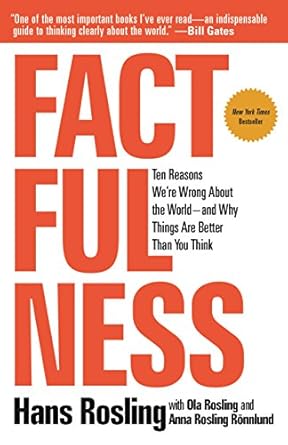
In Factfulness, Rosling doesn’t just present data. He presents a mirror.
A mirror that shows us how wrong our instincts can be about poverty, education, global development, and even what “progress” really looks like.
The surprising part?
It’s not that we don’t know enough facts.
It’s that the facts we think we know are often completely wrong.
And even more surprisingly, we’re wrong in the same direction.
That direction is the negative one.
📉 When Even Experts Get the Basics Wrong
Rosling spent years asking thousands of people across the world, including Nobel Prize winners, CEOs, and policymakers, a set of 13 basic questions about global trends.
For example:
- What percentage of girls in low-income countries finish primary school?
- What is the global average life expectancy?
- How has extreme poverty changed over the past 20 years?
These were multiple-choice questions. Even random guessing should give a 33 percent score.
But in reality, most people scored lower than that.
The average score was less than 20 percent.
Worse than a chimpanzee randomly selecting answers.
This wasn’t just a case of ignorance.
It was a clear sign of systematic misunderstanding.
People assumed the worst. That the world is getting poorer, sicker, and more dangerous.
🌍 The World Is Getting Better (Even If We Don’t See It)
Here are some facts from the book that most people get wrong:
- 90 percent of the world’s children are vaccinated.
- More girls are in school than ever before.
- Extreme poverty has dropped by more than half since 1990.
- Global life expectancy has risen to over 70 years.
So why do we still believe the world is in decline?
Because our brains are wired to pay attention to fear, drama, and worst-case scenarios.
Rosling describes this as a set of ten instincts that cloud our thinking.
These include the negativity instinct, the gap instinct, the fear instinct, and the blame instinct.
Each one shapes how we see the world. And not in a good way.
🧱 What Incomplete Houses in Tunisia Taught Me
There’s a story from the book that really stuck with me.
When tourists visit Tunisia, they often see houses that look half-finished.
Walls without roofs. Exposed bricks. Construction left incomplete.
And the common reaction?
People assume the locals are lazy or poorly organized. That they simply gave up.
But here’s the truth.
In places where banks can’t be trusted and inflation eats away at savings, people use a different strategy.
They buy bricks whenever they can afford them.
Instead of storing the bricks and risking theft, they begin building. Slowly.
Each new brick added to the wall is a form of saving.
Over time, often over many years, the house is completed.
It’s not poor planning. It’s a smart and resilient way to build a future.
⚔️ The Man Who Swallowed Swords to Make a Point
Rosling had a memorable way to end his lectures.
He swallowed a sword.
Why?
Because people instinctively believe it’s impossible.
He used it to challenge that belief.
“If I can train myself to do something that seems dangerous and impossible,” he would say,
“what else do we believe is impossible simply because we don’t understand it?”
This wasn’t just a performance. It was a message.
Our instincts lie to us.
Things that seem frightening or hopeless are often misunderstood.
💬 The Power of Admitting “I Was Wrong”
Rosling didn’t just talk about other people’s blind spots. He talked about his own.
In one of the book’s most powerful chapters, he shares a painful memory from his early career.
While working as a doctor in Mozambique, he advised a city to close its borders due to a mysterious illness.
That decision, based on fear and incomplete data, led to the deaths of dozens of innocent people.
The illness turned out to be non-contagious. It was caused by a toxic reaction from improperly processed cassava.
Rosling carried that guilt for 35 years. He only shared the full story in this book.
This isn’t a book written from a place of superiority.
It’s written from a place of humility, learning, and human error.
🔍 Don’t Look for Villains. Look for Causes.
One quote from the book stays with me:
“Don’t look for villains. Look for causes.
Don’t look for heroes. Look for systems.”
We often try to simplify complex problems.
We want someone to blame. A bad leader. A greedy company. A corrupt politician.
But most of the world’s biggest challenges are shaped by systems, not single people.
The same goes for progress.
No one person ended extreme poverty.
It happened through decades of development, investment, education, and cooperation.
Understanding systems is harder.
But it brings us closer to the truth.
🛠️ What Can We Do Differently?
Reading Factfulness changed how I look at headlines, statistics, and even social media posts.
Now I try to pause and ask myself:
- Am I reacting emotionally or factually?
- Could this be more complex than it appears?
- Is this one example or part of a larger pattern?
You don’t need to become a statistician to think more clearly.
You just need to slow down and be curious.
✨ Final Thoughts
Factfulness is not a book about blind optimism.
It’s about informed hope.
It asks us to stop panicking and start learning.
To be humble enough to say, “I didn’t know that.”
To realize that the world is full of problems, but it is also full of progress.
We just need to learn how to see it.
“Even if the house looks half-built, don’t judge until you know why the bricks are there.”
📚 If You’re Curious
I highly recommend reading Factfulness. Or watch one of Hans Rosling’s TED Talks.
They’re filled with joy, insight, and just the right amount of sword-swallowing.
Not because the world has changed.
But because you might.
 Site Title