7 Surprisingly Smart Ways to Become a Better Reader (Without Reading More)
Ever struggled to remember the last three books you read, or even one useful idea from them?
You’re not alone. But it doesn’t have to be this way.
Bestselling author Daniel Pink has read hundreds of books and distilled what actually works when it comes to reading smarter, not just more. Here are his seven science-backed, battle-tested techniques that can transform your reading life, even if you don’t read faster or longer.
1. Torture Your Books (Yes, Really)
Forget treating books like museum artifacts. If you want to learn from them, beat them up a little. Crack the spine. Underline ruthlessly. Dog-ear pages. Scribble in the margins.
Books should be sparring partners, not sacred relics. The more you mark them up, the more you’re engaging with the content. And that helps you remember it better.
“When readers come to me with dog-eared, scribbled-in books, they often apologize. But I want to hug them.”
2. Summarize Every Chapter
At the end of each chapter, pause and write 2 or 3 sentences summarizing what you just read, in your own words.
This isn’t just a note-taking trick. It forces your brain to think, not just skim. Passive reading is forgettable. Active reading stays with you.
At the end of the book, answer these three questions:
What’s the big idea?
How does the author know?
What should I do?
Put your answers in a Google Doc or notes app. That small habit makes a massive difference.
3. Harvest the Gold
Don’t let your brilliant takeaways vanish. Create a system, like a simple folder or notes file, to store:
Chapter summaries
Underlined quotes
Key insights
Then, when you need inspiration, feed these notes into your favorite AI (ChatGPT, Claude, etc.) and prompt it for ideas, quotes, or themes to use in writing, projects, or conversations.
Example prompt: “I’m pitching a startup idea. What are 3 quotes from my reading notes that would resonate with investors?”
4. Reread to Meet a New You
The book may be the same, but you’re not.
Rereading great books later in life reveals new layers. A book you read at 18 hits completely differently at 38, because life has added context, wounds, and wisdom.
Read deep in your area of expertise, and wide outside of it.
Like the letter T, go deep in your niche [specialized area of interest or expertise] but also broad across fields like psychology, history, art, or even poetry. This combo fuels creativity and cross-pollination [mixing ideas from different fields or areas to create something new or better] of ideas.
Pink’s favorite example? He read graphic novels for fun, and later wrote a business book in that very format.
6. Quit Books (Without Guilt)
Yes, quit. If a book isn’t working for you, let it go. It’s not your fault. It’s the author’s job to keep you engaged.
Use this formula to decide:
100 – your age = number of pages to give a book before quitting. (If you’re 40, give it 60 pages. If it’s not clicking, move on.)
Life is too short for boring books.
7. Don’t Stress About Speed or Scope
You’ll never read everything. That’s okay.
Celebrate what you have read instead of worrying about what you haven’t. Read at your own pace. Speed reading is mostly a myth. Depth matters more than speed.
“Reading is one of life’s great privileges. Do it with intention, rigor, and joy.”
TL;DR: Read Better by Doing Less
You don’t need to read faster or longer. You just need to:
Engage deeply
Summarize actively
Store what matters
Reread purposefully
Read wide and deep
Quit guilt-free
And enjoy the process
Reading isn’t just about absorbing information. It’s about changing who you are, one well-worn, dog-eared page at a time.
Here are the refined, natural expressions from the script, perfect for enhancing conversational fluency and connection when discussing entertainment like movies and shows:
1. Keep you guessing
Meaning: To maintain suspense and make you unsure of what will happen next. Examples:
This crime series really kept me guessing until the very end.
The plot twists kept me guessing the entire time.
2. Keep you on your toes
Meaning: To keep you alert or constantly paying attention. Examples:
Parenting definitely keeps you on your toes.
That show is full of surprises. It keeps me on my toes.
3. A twist
Meaning: An unexpected development in a story. Examples:
There was a huge twist in the last episode. I didn’t see it coming.
I love stories with a good twist—they make the whole experience more engaging.
4. I didn’t see it coming
Meaning: The outcome was completely unexpected. Examples:
When the villain turned out to be the hero’s brother, I didn’t see it coming.
The ending totally surprised me—I didn’t see it coming at all.
5. Leave you in suspense
Meaning: To make you wait anxiously to know what happens next. Examples:
Every episode ends in a way that leaves you in suspense.
The book leaves you in suspense after every chapter.
6. Cliffhanger
Meaning: A dramatic ending that leaves the outcome unresolved, usually prompting you to come back for more. Examples:
They ended the season with a cliffhanger—I can’t wait for the next one.
That show is full of cliffhangers, which makes it so addictive.
🎭 Role Play Scene
Scenario: Two friends catching up after watching a suspenseful movie.
A: Hey! So, how was the movie you saw last night? B: Oh, it was amazing. It kept me on my toes the whole time. A: Nice! Were there any twists? B: Huge one. I didn’t see it coming at all. The plot really kept me guessing. A: Sounds like something that would leave me in suspense. B: Definitely. Every scene built up to something unexpected.
📝 Example Paragraph Using All Expressions
Last night, I watched a thriller that absolutely kept me guessing from start to finish. Just when I thought I had figured it out, there was a twist that completely changed everything—I didn’t see it coming at all. The pacing was tight, and it kept me on my toes the whole time. By the end, the story left me in suspense, and of course, they wrapped it up with a major cliffhanger. Now I’m counting the days until the next season drops.
🎤 Q&A: After Reading That, You Might Be Wondering…
1. Q: “Until the very end” sounds dramatic. Is it just a fancier way of saying “until the end”? A: Pretty much, but that little word “very” adds a strong emphasis. It highlights that something continued all the way to the final moment. If you say “until the very end,” you’re not just talking about time passing. You’re stressing that whatever was happening, it never let up for even a second.
2. Q: In the sentence “The plot twists kept me guessing the entire time,” is “the entire time” what I was guessing? A: No. You’re not guessing the time itself. “The entire time” tells us how long you were in a state of guessing. The object of “kept” is “me,” and “guessing” is the state you’re being kept in. So it means you kept trying to figure things out from beginning to end.
3. Q: But wait, can I say “guess the entire time” if I’m literally trying to figure out how long something will take? A: Yes, in that case, “the entire time” becomes the object of “guess.” For example, “Can you guess the entire time it’ll take to finish the project?” Here, you’re estimating the total duration. The meaning is different, and it’s perfectly correct.
4. Q: “Cliffhanger” sounds like someone is about to fall off a mountain. Where did that word come from? A: It actually comes from that exact idea. In the 1800s, serialized novels and early films would end with the hero literally hanging off a cliff. The story would pause right there, making readers or viewers wait until the next installment to find out what happened. That’s how it became a metaphor for any story that ends at a high-tension moment.
5. Q: What’s the deal with “suspense”? How is it different from just being nervous or tense? A: Suspense is a specific kind of tension. It comes from not knowing what’s going to happen next and caring about the outcome. It’s what keeps you watching, reading, or listening. It’s not just nervous energy, it’s controlled uncertainty that pulls you forward.withholding just enough detail, and pacing are all part of the suspense toolkit — whether in books or at brunch.
Here’s a complete breakdown of the refined daily expressions, role play scripts, and a paragraph incorporating all expressions from the episode “Take the Social Pressure Off with a Theme Night” by All Ears English.
✅ 1. Daily Expressions & Idioms from the Episode
These expressions are useful for casual invitations, forming social connections, and navigating early-stage friendships with tact and clarity:
🗣 “Take the pressure off”
➡️ Meaning: To relieve someone from stress or expectations. Example: Having a theme night really takes the pressure off when inviting new friends over.
🗣 “Cooped up”
➡️ Meaning: Feeling confined or trapped indoors. Example: I hate being cooped up all day; that’s why I love outdoor gatherings.
🗣 “Break the ice”
➡️ Meaning: To initiate conversation or interaction in a social setting to reduce tension. Example: Cooking together was a great way to break the ice with our new neighbors.
🗣 “Blend your bubbles”
➡️ Meaning: To bring together different social groups (e.g., work friends, school friends). Example: Hosting a wine and cheese night is a great way to blend your bubbles.
🗣 “There’s a spark” (friendship spark)
➡️ Meaning: There’s potential for a deeper connection or relationship. Example: We met at a community event and felt a bit of a friendship spark.
🗣 “Take it to the next level” (social context)
➡️ Meaning: To deepen or advance a relationship. Example: We’d been chatting at work for months, but starting a book club really took our friendship to the next level.
🗣 “Be specific”
➡️ Meaning: Provide clear and detailed information (especially in invitations). Example: Be specific when inviting someone—say what you’re doing and when.
🗣 “I’ve been meaning to ask…”
➡️ Meaning: A polite way to bring up something you’ve wanted to talk about. Example: I’ve been meaning to ask—would you be interested in joining a potluck next weekend?
🗣 “Theme night” / “[Noun] night” construction
➡️ Meaning: A night focused on a specific theme or activity (e.g., game night, pizza night). Example: We’re having a movie night on Friday—want to join?
🗣 “Automatic conversation starter”
➡️ Meaning: A topic or element that naturally prompts discussion. Example: Cooking together is an automatic conversation starter.
🎭 2. Role Play Scripts
🎙️ Role Play: Work Friends Inviting Each Other Over
A: Hey, Lindsay. B: Hi! A: Would you be interested in coming over tomorrow for pizza making night? My friends and I love to try new pizza recipes. B: Oh wow, that sounds delicious! Sure. Also, I’ve been meaning to ask you—I’m thinking about starting a book club. Are you interested? A: Yes! That sounds awesome.
🔹 This is a natural exchange showing how to initiate casual social plans without pressure.
🧩 3. Integrated Paragraph Using All Expressions
Last weekend, I finally decided to take the pressure off and invited a few colleagues over for a pizza making night. I’ve been feeling a bit cooped up since the weather turned cold, so it felt great to be social again. Cooking together really helped break the ice, and I realized there was a bit of a spark with some of them—we might even take it to the next level and start a book club. One of them said, “I’ve been meaning to ask if you do potlucks—we should plan one soon!” What surprised me most was how well the group clicked; I guess blending your bubbles really works when you add a structure like a theme. It was fun, relaxed, and the pizzas became an automatic conversation starter—especially the debate over pineapple toppings!
✅ 4. Language Curiosity: My Questions and What I Learned
Q1: Can you really say “pizza making night”? It feels odd to describe a night that way.
A: Yes! It’s completely natural in English to use “[noun/verb-ing] + night” constructions to name themed gatherings.
👉 In “pizza making night,” the phrase “pizza making” acts like an adjective, describing what kind of night it is. This is a common and flexible structure, especially in casual conversation.
🧠 Formula to remember:
[activity in -ing form] + night/day/event = A night focused on that activity.
✅ Examples:
wine tasting night
cookie baking day
team building event
pumpkin carving night
Once you recognize this pattern, you can easily create your own theme nights!
Q2: What exactly does “cooped up” mean? Where does that come from?
A: “Cooped up” is an idiom that comes from the idea of a chicken in a coop (a small cage)—trapped and unable to move freely. When someone says they feel “cooped up,” it means they feel confined indoors, often for too long, and want to get out.
✅ Example:
I’ve been cooped up in my apartment all week. I need some fresh air!
It’s especially common when talking about working from home, bad weather, or winter months.
Q3: In “blend your bubbles,” what does “bubble” actually mean?
A: Great question! In this context, “bubble” refers to a social group—like work friends, family friends, or school parents.
➡️ “Blending your bubbles” means inviting people from different parts of your life to the same event and encouraging them to mix. This term became especially popular during the pandemic but is now used more generally to talk about combining social circles.
✅ Example:
We’re hosting a wine night to blend our bubbles—coworkers, neighbors, and yoga friends.
Q4: Why is it “What surprised me most,” not “the most”?
A: In this sentence, “most” is functioning as an adverb, meaning “to the greatest degree.” When “most” is used this way (after a verb like surprise, impress, matter), it’s completely fine—and even more natural—to drop “the.”
✅ Examples:
What matters most is honesty.
What helped me most was your support.
What impressed me most was her confidence.
👉 “The most” isn’t wrong, but “most” alone sounds more conversational and is frequently used by native speakers.
Q5: Why do we say “an automatic conversation starter”? Is “starter” countable?
A: Yes, “starter” is a countable noun, which is why we use the article “an” in front of it.
🧠 A quick tip for identifying countable nouns:
You can use “a/an”, make plurals (add -s), and use them with “many.”
✅ For example:
a conversation starter
two conversation starters
many icebreakers
So:
“An automatic conversation starter” = One specific thing that helps begin a conversation.
Other common countable nouns like this include: tip, suggestion, question, idea, tool.
This episode from All Ears English does a great job highlighting the nuanced difference between “happen to” and “happen for”—two everyday expressions that carry very different tones depending on usage. Let’s break it down into your requested format:
✅ Refined Daily Expressions & Idioms from the Script
Here are the most useful expressions and idioms that elevate conversational skills and help you speak with nuance, especially for long-term U.S. residents.
1. Happen to (someone/something)
Meaning: Something occurred unexpectedly, often out of your control. Tone: Neutral or negative; the person is often affected passively. Example:
“What happened to your car?”
“It happened to us while we were parked—someone sideswiped the car.”
“If anything happens to me, call my mom.”
Usage tip: Often used when describing accidents, surprises, or unexpected incidents.
2. Happen to (verb)
Meaning: Something occurred by chance or coincidence. Tone: Neutral or light; indicates coincidence or randomness. Example:
“I happened to see your sister at the farmers market.”
“If you ever happen to be in the area, stop by.”
Usage tip: Use this to politely suggest, or describe a chance encounter. It softens the sentence.
3. Happen for (someone)
Meaning: Something good occurred in someone’s favor, often implying it was meant to be or the result of effort. Tone: Positive, intentional, often reflects benefit or purpose. Example:
“I’m really happy this happened for her—she’s been needing a fresh start.”
“Everything seemed to happen for me at once—I got a new job and met amazing people.”
Usage tip: Great for encouraging or validating someone’s progress or life events.
4. Everything happens for a reason
Meaning: A popular saying implying that events—especially difficult ones—have a greater purpose. Tone: Philosophical, but can come across as dismissive in sensitive situations. Example:
“Well, maybe it didn’t work out because something better is coming—everything happens for a reason.”
Usage tip: Be cautious with this; use it only if the person you’re talking to shares a similar outlook or welcomes comfort in that form.
5. Play devil’s advocate
Meaning: To present an opposing or alternative viewpoint for the sake of argument or deeper thought. Example:
“Just to play devil’s advocate, couldn’t we say good things happen to those who wait too?”
Usage tip: This expression helps you soften disagreement or introduce a counterpoint diplomatically.
🎭 Role Play Script from the Episode
Context: Two friends chatting while waiting for a gym class to start.
Friend 1: Hey, what happened to your phone? The screen looks cracked.
Friend 2: I dropped it yesterday. Luckily, it had a screen protector, so the actual screen didn’t crack.
Friend 1: Oh, well that’s good. By the way, I happened to see your sister at the farmers market this morning. She said she’s moving to Seattle.
Friend 2: Yes, I’m super bummed she’s moving. She just accepted a job there.
Friend 1: Oh, that’s so far. I know you two are really close. You’ll have to go visit.
Friend 2: I for sure will. I love Seattle, and I’m really happy this happened for her. She’s been looking for a fresh start.
🧾 Sample Paragraph Using All Expressions
Last weekend, something crazy happened to me—I was parked at the farmers market when someone sideswiped my car and drove off! But on the bright side, I happened to run into my old college friend there, which totally lifted my mood. We chatted for a while, and she told me she finally got her dream job in New York. Honestly, I’m thrilled this happened for her; she’s been working so hard to make that move happen. Later that evening, another friend said, “Well, you know, everything happens for a reason,” but I wasn’t sure how to take it—to play devil’s advocate, sometimes bad stuff is just random. Still, it got me thinking.
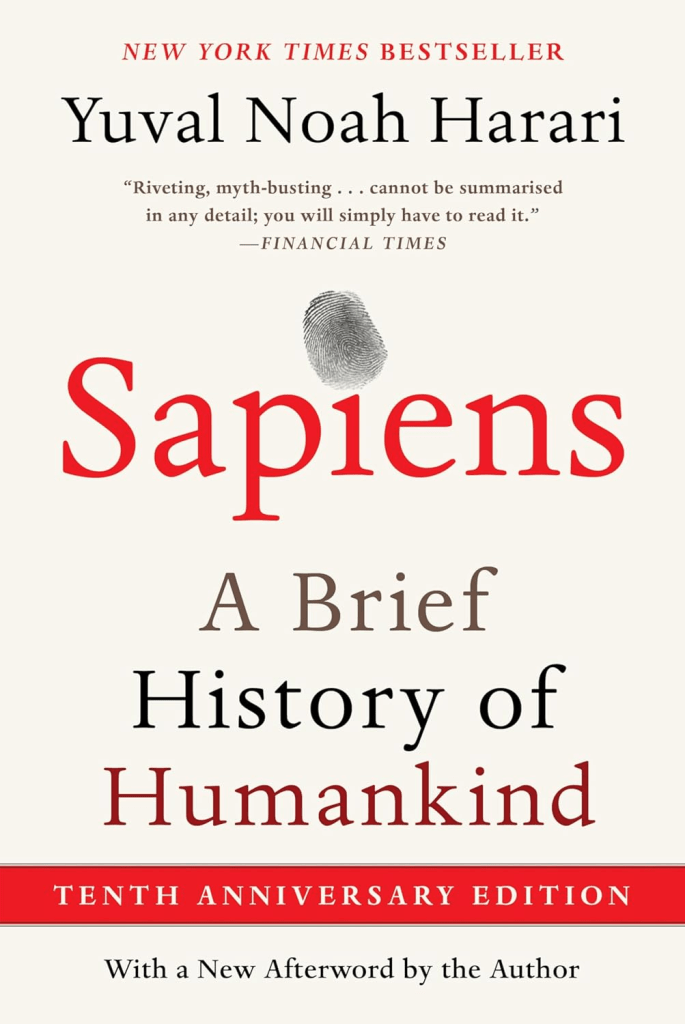
Let’s be honest. You’ve probably heard of Sapiens by Yuval Noah Harari, maybe even bought it, but never quite made it past chapter two. You’re not alone.
At over 400 pages of history, biology, economics, and philosophy, Sapiens is a modern classic that feels more like a marathon than a book. But what if you could get the essence of it, not a summary but the core insights, in ten minutes?
Let’s do exactly that. Below are seven powerful takeaways from Sapiens that help explain who we are, how we got here, and why our world is built the way it is. These points go beyond summaries. They are ideas you will actually think about after you close this tab.
And if the book ever felt too long or too dense, this is where to start.
1. Humans dominate the Earth not because we’re strong, but because we believe in fiction
Around 70,000 years ago, humans experienced what Harari calls the Cognitive Revolution. It wasn’t about walking upright or using fire. Other animals did that too. The real game-changer was the ability to imagine things that don’t exist, talk about them, and convince others to believe in them.
Think about gods, nations, human rights, companies, and money. None of these things exist in nature. Yet, we organize our entire lives around them.
This ability to create and share collective myths gave Homo sapiens an edge over every other species. We cooperate in large numbers not because we are kind, but because we believe in the same stories.
The real superpower of humans is storytelling. That is what makes mass cooperation and civilization possible.
2. The greatest leap in knowledge came when humans admitted they didn’t know everything
One of the most profound ideas in Sapiens is this. The scientific revolution began with humility.
Up until the 1500s, most societies believed they already had all the answers. These answers were often found in holy books or ancient philosophy. When faced with something unknown, people assumed it either didn’t matter or was unknowable.
But then something changed. Scientists started saying, “We don’t know, but we want to find out.”
That small shift in mindset led to everything from Newton’s laws to space travel. In fact, old world maps before the 16th century were completely filled in, even if parts were imaginary. Later maps began leaving blank spaces. This was an honest admission of ignorance, which sparked exploration, curiosity, and massive technological progress.
Acknowledging that we don’t know something is not a weakness. It is the beginning of real knowledge.
3. Humans didn’t become rulers of the planet by being virtuous. We disrupted the ecosystem
Why are humans at the top of the food chain? Not because we were morally superior or stronger. We simply moved too fast.
Harari points out that when predators like lions or sharks rose to the top, it took millions of years. This gave the ecosystem time to adapt. But humans rose in just a few thousand years, which is almost overnight in evolutionary terms.
Other animals had no time to adjust. This led to mass extinctions and ecological damage. For example, many large mammals disappeared shortly after humans reached Australia and the Americas.
Our domination is not natural. It is disruptive. We are not the top because we fit in, but because we changed the rules too quickly.
4. Human progress does not equal human happiness
This one hits hard. Yes, we have cities, smartphones, and life-saving medicine. But are we really happier than ancient foragers who roamed the land freely, ate a diverse diet, and worked fewer hours?
Harari argues that the Agricultural Revolution, which we usually celebrate, was a mixed blessing. It allowed population growth, but also introduced hard labor, poor diets, inequality, and disease. People settled down to grow wheat, but wheat ended up domesticating us.
The species succeeded, but the individuals may have suffered.
This idea leads to a haunting insight. More people, more tools, more power, but not necessarily more joy.
5. Civilizations grow when people believe in the same imaginary rules
Humans didn’t build pyramids, nations, and corporations just because of tools or intelligence. We built them because we believe in shared fictions.
These shared beliefs are what Harari calls imagined orders, such as money, religion, and law. They aren’t real in the way gravity or atoms are. But they are powerful because we act as if they are real.
A dollar bill only has value because millions of people agree that it does.
Even things we cherish, such as human rights or democracy, are ideas we’ve created, believed in, and institutionalized. They are not biological facts. They are collective beliefs that structure our world.
If enough people believe in the same story, it becomes the reality we live in.
6. Capitalism works because people believe tomorrow will be better
Why would someone lend money or take out a loan to start a business? It only works if both sides believe in a common story. That story is that the future will be bigger, richer, and better.
That is the core of capitalism. It is not just about money. It is about trust in future growth. Harari explains that modern economies are built not just on hard currency, but on credit. Credit only exists when there is belief in future returns.
This belief has driven explosive progress, but it also led to things like colonialism, slavery, and climate change. Capitalism is powerful, but not always moral.
Capitalism depends on the story that growth is endless. But what happens when that story stops making sense?
7. We live inside systems we’ve created, but we forget they’re invented
Today, we take certain values for granted. Freedom, equality, patriotism, success. But none of these are universal truths. They are ideas we have invented, accepted, and passed down.
The most dangerous myths are the ones we forget are myths.
From ancient religions to modern nationalism, humans are storytelling animals. That is both our strength and our weakness. We can unite by the billions or divide just as easily.
History is not just what happened. It is the stories we chose to believe about what happened.
So… What’s the real message?
Let’s go back to a question many readers ask.
If civilization has advanced so much, why doesn’t it always feel better?
That is the key idea Harari wants us to wrestle with. We have conquered nature, built empires, and explored galaxies, but still struggle with loneliness, burnout, and meaning.
Progress is not always personal. The human species may be thriving, but the individual human is not always doing better.
That is not to say things were better in the past. But Sapiens makes us question the automatic assumption that more is always better, and that newer is always wiser.
If the book felt overwhelming, just remember this:
We rule the Earth because we tell stories
Those stories only work if people believe them
Belief, not truth, is the foundation of civilization
And if you never finish Sapiens, that’s okay. Knowing these seven ideas might be even more powerful than reading all 400 pages.
Too long, too complex, too late to start reading the whole book? No problem. You just did.
“Why do white people have so much cargo?” — Yali, a New Guinean politician
This was the question that changed everything for scientist Jared Diamond. A local politician in Papua New Guinea asked him why some countries seem so rich and powerful while others are not.
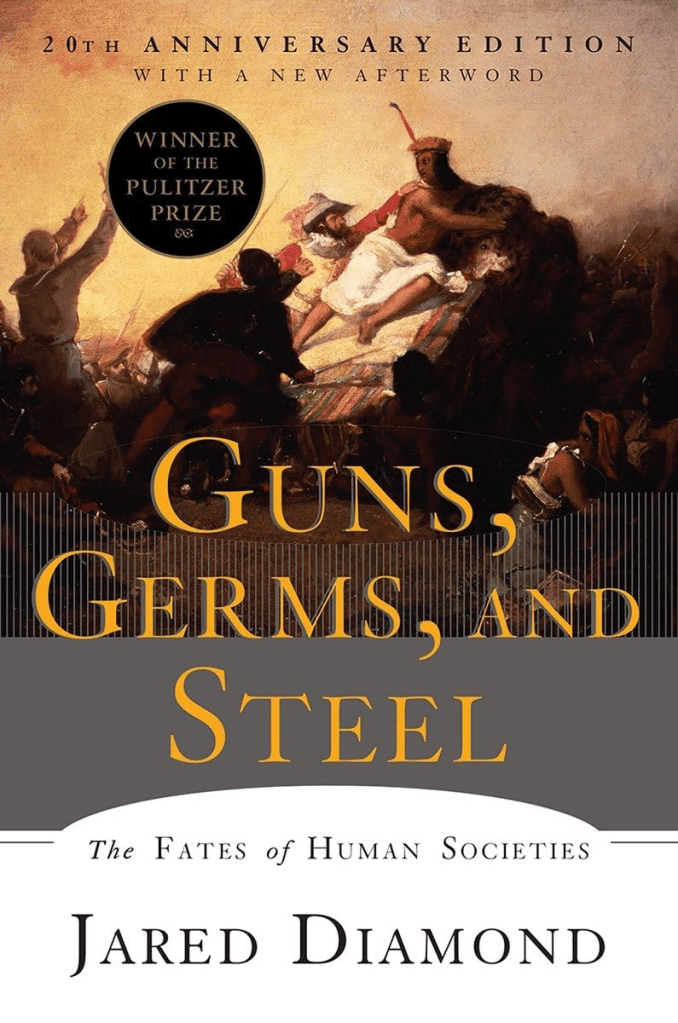
Diamond could not stop thinking about it. That one question became a global best-seller, a Pulitzer Prize-winning book, and a completely new way of understanding human history. That book is Guns, Germs and Steel.
Many people start reading it and give up after a few pages. It feels like a textbook. But behind the complex language is a simple and powerful idea:
The real cause of inequality in the world is geographic luck, not intelligence, culture or race.
Let’s break it down in a way that anyone can understand. In this article, we will walk through the seven key ideas in Guns, Germs and Steel. These ideas explain why some civilizations grew rich and powerful while others struggled to survive.
1. It’s Not About Race. It’s About Environment.
One of the most dangerous and outdated beliefs in history is that people in rich countries are more intelligent or more hardworking than others.
Diamond completely rejects this idea.
He says that Europe and Asia developed faster not because of better people, but because they had better starting conditions after the last Ice Age.
Some areas had the right kinds of wild plants and animals to support farming. Others did not.
Some continents had flat land, easy travel routes and mild climates. Others were filled with deserts, jungles and extreme weather.
Over thousands of years, these small differences led to huge inequalities in technology, health, population and power.
2. Farming Was the First Big Step
Before farming, humans lived by hunting and gathering. But farming changed everything.
People could now grow their own food, store it, and stay in one place. This led to:
Bigger populations
Permanent villages and cities
Special jobs (like leaders, soldiers and builders)
Inventions like writing, math and government
But here’s the key point. Farming was not possible everywhere.
The earliest crops like wheat, barley and rice only grew wild in certain parts of the world. These plants could be domesticated, meaning humans could plant and harvest them easily.
Places like the Middle East, China and Central America had good luck. Other places, like Australia or southern Africa, did not.
So even if people were equally smart, they did not have the same tools to build civilizations.
3. Animals Made a Huge Difference
Farming plants was important, but domestic animals were even more powerful.
Animals like cows, sheep, pigs and horses helped with:
Plowing fields (which increased food)
Providing milk, meat and hides
Carrying goods long distances
Helping in war (especially horses)
But again, only a few parts of the world had animals that could be tamed.
There are very strict requirements for domestication. The animal must:
Eat plants (not meat)
Grow quickly
Be friendly and calm
Live in groups
Be okay with being controlled by humans
Zebras, elephants and kangaroos do not qualify. Horses, cows and goats do.
And guess what? Most of the animals that humans could tame were found in Eurasia, not in the Americas or Africa.
This gave some societies a huge head start.
4. East-West Shaped Civilization. North-South Did Not.
Another big idea in the book is about the shape of continents.
Eurasia (Europe and Asia together) stretches east to west. The Americas and Africa stretch north to south.
That matters because plants, animals and technologies spread more easily across areas with similar climates.
If you move east or west, the climate stays about the same. But if you move north or south, the temperature, rainfall and seasons change a lot.
For example, if a new crop is developed in China, it can spread west into the Middle East and then into Europe.
But a new crop from Mexico would have a hard time reaching Peru. It would have to pass through deserts, jungles, mountains and tropical zones.
That is one reason why technology spread so fast in Eurasia but stayed isolated in the Americas and Africa.
5. Germs Were the Most Deadly Weapon
When Europeans arrived in the Americas, they had steel swords and guns. But their most powerful weapon was something invisiblegerms.
Diseases like smallpox, measles and flu killed up to 90 percent of Native Americans. In many cases, entire tribes were wiped out before a single shot was fired.
Why was this so deadly?
Because people in the Americas had never lived with large animals. That means they had not been exposed to the kinds of diseases that came from livestock.
Europeans, on the other hand, had spent centuries living with cows, pigs and chickens. Over time, their bodies developed resistance to many deadly germs.
The germs themselves evolved too. So when Europeans arrived, they brought diseases that spread fast and killed millions, often without even realizing it.
6. Inventions Don’t Change the World Until Society Is Ready
Many people believe that when we need something, we invent it.
Diamond flips that idea around.
He says invention creates need, not the other way around.
For example:
Thomas Edison invented the phonograph to record office meetings, not for music.
Gasoline was once thrown away as useless waste during oil processing.
The QWERTY keyboard was designed to slow down typists. Yet we still use it today.
The point is this. A great invention does not guarantee success. What matters is whether society is willing and able to adopt it.
Some technologies are ignored or forgotten because the culture, economy or politics are not ready for them.
7. Writing Systems Changed Everything
Writing is one of the most important inventions in history. It allows humans to:
Record laws and taxes
Share stories and ideas
Organize large societies
Educate future generations
But surprisingly, only three civilizations created writing from scratch:
The Sumerians in the Middle East
The Chinese
The Maya in Central America
All other writing systems were borrowed or inspired by these three.
For example:
The Roman alphabet (which we use today) was based on older alphabets like Phoenician.
Korean Hangul is a unique case. It was inspired by the idea of writing, but built from new principles. Diamond calls Hangul a linguistic miracle.
He also praises Hangul for being simple, logical and easy to learn, especially for beginners.
Bonus: What About Famous Leaders Like Hitler or Columbus?
You might wonder, what about leaders like Hitler or Columbus? Didn’t they shape history?
Diamond agrees that individual people matter, but only to a point.
If Hitler had died early, maybe someone else would have taken his place. The forces of history, such as resources, technology, and political systems, would still exist.
This is why Diamond focuses on geography and systems, not just famous names.
Final Message: Geography Set the Stage. We Just Played the Roles.
Jared Diamond’s main argument can be summarized in one simple sentence:
The world is unequal not because of better people, but because of better geography.
No civilization is naturally superior. No race is born to conquer others.
The real difference comes from climate, crops, animals, and whether ideas can move easily across the land.
It may not feel exciting. It’s not the story of genius kings or dramatic battles. But it is the truth behind 13,000 years of human history.
What You Can Do Next
If you have a copy of Guns, Germs and Steel on your shelf, maybe it’s time to pick it up again.
Start with this question:
Why does the world look the way it does today?
And then read with curiosity, not guilt. You don’t have to agree with everything Diamond says. But his ideas will make you think deeper about history, fairness, and the future.
Bonus Recommendation: Watch The Revenant
Want to see some of these ideas in action?
Watch The Revenant (2015) starring Leonardo DiCaprio. It’s not just about a bear attack. The film also shows the tension between Native Americans and Europeans — including the invisible violence of disease and cultural destruction.
It’s about how you handle fear, desire, patience, and pride. That’s why two people with the same income can live completely different financial lives.
This book doesn’t tell you how to make money. It teaches you how to think about it. And in doing so, it shows you how to find something even more valuable: freedom.
1. Wealth Means Freedom, Not Stuff
Here’s a hard truth.
Driving a luxury car shows that you spent money. Having money in the bank or invested quietly? That’s real wealth.
“Spending money to show people how much money you have is the fastest way to have less money.” — Morgan Housel
True wealth is invisible. It’s not flashy or loud. It’s the ability to say things like:
“No, I don’t want to do that.”
“Yes, I’ll take the afternoon off.”
“I’ll live life on my terms.”
2. Behavior Is More Important Than Intelligence
You don’t need a finance degree to build wealth. You need patience, consistency, and emotional control.
“Doing well with money has little to do with how smart you are and a lot to do with how you behave.”
A janitor who saves for 40 years can become wealthier than a doctor who overspends. What matters most is not how much you earn but how well you manage your behavior.
Small, smart choices repeated over time matter more than clever strategies.
3. Save, Not to Buy, But to Be Free
“Saving money isn’t about sacrifice. It’s about creating space.” — Heegu Song
Most people save money to spend it later. But both Morgan Housel and Korean author Heegu Song challenge that idea.
They believe saving is not about delayed consumption. It’s about building a buffer between you and stress. It’s about creating space, not things.
“The highest form of wealth,” Housel writes, “is the ability to wake up every morning and say, ‘I can do whatever I want today.’”
Heegu Song lives this way every day. Even after achieving financial independence, he wakes up before dawn, takes public transportation, and arrives at the office before anyone else.
He does this not because he has to but because he chooses to. He values simplicity, structure, and self-discipline.
Each small act, like riding the train instead of driving or working when no one expects him to, is a reminder to himself.
“I’m not doing this because I have to. I’m doing it because I choose to.”
Saving becomes less about giving things up and more about protecting your future energy. It gives you room to make better choices and live with more intention.
4. Luck, Risk, and Humility
The book also explores two often overlooked truths about money: luck and risk.
Bill Gates became Bill Gates partly because his high school had a computer, which was extremely rare at the time.
On the other hand, many smart investors fail simply because of bad timing.
The lesson is clear.
You don’t always succeed just because you’re smart. And you don’t always fail because you made bad decisions.
Be humble. Be kind. Give yourself and others grace.
5. Focus on What You Can Control
You can’t control the economy, inflation, or the stock market. But you can control:
How much you save
How you react to uncertainty
What you spend on
Who you try to impress
These daily decisions may seem small, but over time, they shape your entire financial life.
And more importantly, they shape your peace of mind.
Final Thought: Real Wealth Is Quiet
Many people chase money hoping it will bring them freedom. But Morgan Housel and Heegu Song show us a better path.
Freedom doesn’t come from earning more. It comes from needing less, choosing wisely, and living intentionally.
Wealth isn’t the expensive car. It’s the car you didn’t buy, the morning you kept for yourself, and the time you spent thinking clearly because your life wasn’t ruled by money.
Real wealth is quiet. It’s not something you show off. It’s something you feel — when you finally have the space to choose.
📌 Save this post if you want to feel more at peace with your money.
Next time, we’ll explore why doing less can sometimes make you richer.
Would you like this post prepared in Markdown for Medium? Or are you thinking about turning this into a series on time, money, and freedom? Let me know. I’m here to help you build it. ✨

 Site Title