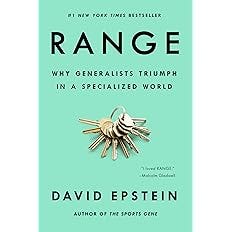
What Range taught me about growth, doubt, and the quiet power of small daily learning
Most people ask the same question the moment they start learning something new:
“What am I going to use this for?”
And maybe, because of that question, we have walked away from too many possibilities too early.
That question sounds practical. Responsible, even. We ask it because we do not want to waste time. We want to know whether a book, a skill, or a new field of study will lead somewhere real. We want proof that our effort matters.
But learning rarely works that way.
At the beginning, it almost never looks useful. It looks slow. Unclear. Unimpressive. You read a book and nothing changes overnight. You spend weeks exploring a new subject and still cannot explain exactly where it is taking you. You put in the hours, but the results do not arrive on schedule.
That is when doubt enters.
Should I keep going?
Am I wasting time?
Should I stop and choose something more certain?
Lately, I have been thinking about those questions through the lens of one book: David Epstein’s Range.
And the more I think about it, the more I realize that the real challenge of learning is not simply staying disciplined. It is learning how to live through uncertainty without quitting too early.
Why Range matters
Range pushes against one of the most popular ideas in modern culture: that the people who win are the ones who specialize early, choose quickly, and go all in before anyone else.
We admire people who seem to know from the start. The ones who pick one path early, commit to it, and move forward with speed and certainty. We treat that kind of clarity as the ideal model of success.
But Epstein tells a different story.
He argues that many of the most creative, resilient, and effective people do not begin with a narrow path. They explore. They try different things. They move across disciplines. They gather experiences that may not seem connected at first. And later, those experiences become the source of better judgment, deeper insight, and stronger problem-solving.
That is what “range” really means in this book. Not being scattered. Not being unfocused. But developing a wider frame of reference — one that allows you to connect ideas, see patterns, and think beyond the limits of a single track.
That is why this book stayed with me.
It gave me a language for something I had felt before but had never clearly named: not all growth is visible when it begins, and not all meaningful learning looks efficient at first.
Some of the most important things we learn only make sense later.
Learning is not immediate progress. It is collecting pieces.
Recently, I came across a conversation that put this idea into words in a way I could not forget. It described learning as collecting puzzle pieces — a process of adding small fragments day by day, even when the whole picture is still invisible. It also framed daily study as something that compounds over time, especially when knowledge from different fields starts to connect.
That image changed the way I think about studying.
A single puzzle piece tells you almost nothing. One blue piece could belong to the sky, the ocean, or the corner of a window. One curved line means very little on its own. Looking at one piece, you cannot see the picture.
Learning often feels exactly like that.
A sentence from a book.
An idea from a lecture.
A conversation that stays in your mind.
A failure you do not understand yet.
Each one feels small. Isolated. Easy to dismiss.
That is why people quit too early. They look at one piece and decide there is no picture. They expect clarity before accumulation. They want meaning before enough material exists to reveal it.
But that is not how growth works.
At first, you collect pieces. Then, after enough time, they begin to connect. And when they connect, what once looked random starts to look inevitable.
That is the quiet power of learning: it often becomes visible only after it has been building for a long time.
The value of two quiet hours a day
From the outside, two hours of study a day does not sound dramatic.
It is not the kind of habit people post about with fireworks. It does not look like a breakthrough. It does not feel like transformation in real time.
But two hours a day is not small.
Two hours a day is how you build a private foundation. It is how you deepen your thinking before the world notices. It is how you prepare for connections that have not revealed themselves yet.
The problem is that most people judge learning by daily results. They ask, “What changed today?” And because the answer is often “not much,” they stop.
But learning is not weak because it is slow. It is powerful because it compounds.
A day of study may not change your life.
A week may not either.
But months and years of steady learning can change the way you see, decide, build, and endure.
And when that learning comes from more than one field, its power becomes even greater. That is one of the most valuable ideas in Range: knowledge does not only grow by going deeper. Sometimes it grows by connecting across differences.
History changes how you understand technology.
Philosophy changes how you make decisions.
Psychology changes how you read data.
Art changes how you notice what others miss.
That is why broad learning often looks inefficient in the short term and becomes powerful in the long term. It does not always move in a straight line. But it gives you more ways to think, more patterns to recognize, and more tools to make sense of complexity.
Going all the way is not the same as simply enduring
Still, one question remains.
What should we do when doubt appears?
Should we just keep going because we already chose the path? Should we force ourselves to endure until meaning appears?
I do not think the answer is blind persistence.
There is a difference between going the distance and just hanging on.
That difference is reflection.
Real learning does require patience. There is almost always a phase where the meaning is not clear yet — where the results are invisible, and the path feels uncertain. If we expect instant clarity, we will abandon too many things before they have the chance to become meaningful.
But reflection matters just as much as persistence.
Sometimes what we need is not to run faster, but to pause.
To stop for a moment and ask:
What am I actually learning here?
What is accumulating, even if it is not obvious yet?
What questions am I starting to ask differently?
What am I noticing now that I could not see before?
That kind of pause is not weakness. It is not hesitation. It is part of the work.
Reflection is how we distinguish between meaningful uncertainty and empty repetition.
Some paths feel confusing at first because growth is still forming underneath the surface. Other paths remain empty because they are not ours to keep pursuing. The only way to tell the difference is to pause long enough to examine what is happening.
So no, I do not think the answer is to push through everything at all costs.
I think the answer is this:
Stay with the work long enough to let it reveal something. But pause often enough to notice whether anything is being built.
That is not quitting. That is wisdom.
What changed for me
For a long time, I treated learning like an investment that needed to justify itself quickly. If I could not explain where it would lead, I became restless. If the payoff was not visible, I assumed the effort might not be worth it.
Now I see it differently.
Learning is not always a transaction. Sometimes it is construction.
You are not always earning immediate returns. Sometimes you are gathering materials. Building structure. Strengthening ways of thinking that will matter later, in places you cannot predict yet.
That shift has brought me a strange kind of peace.
I no longer feel the need to demand instant usefulness from everything I study. I still care about direction. I still believe in focus. But I have more respect now for the quiet period — the season when the pieces are accumulating but the image is not visible yet.
And I have come to believe that growth needs two things at once:
the discipline to continue,
and the courage to pause and examine.
Not every doubt means you should stop.
But not every continuation is meaningful either.
The point is not to keep going mindlessly. The point is to keep going attentively.
A better question
So maybe the problem is not that we ask questions when we learn.
Maybe the problem is that we ask the wrong one too early.
Instead of asking, “What am I going to use this for?”
maybe we should ask:
“What piece am I collecting right now?”
That question changes everything.
It makes room for uncertainty.
It respects the slow nature of growth.
It allows us to continue without demanding instant proof.
And it reminds us that not all meaning appears on day one.
Some of the most important things in life do not arrive as answers. They arrive as pieces.
A thought.
A habit.
A sentence.
A new way of seeing.
And one day, almost quietly, they connect.
That is when the picture begins to appear.
 Site Title