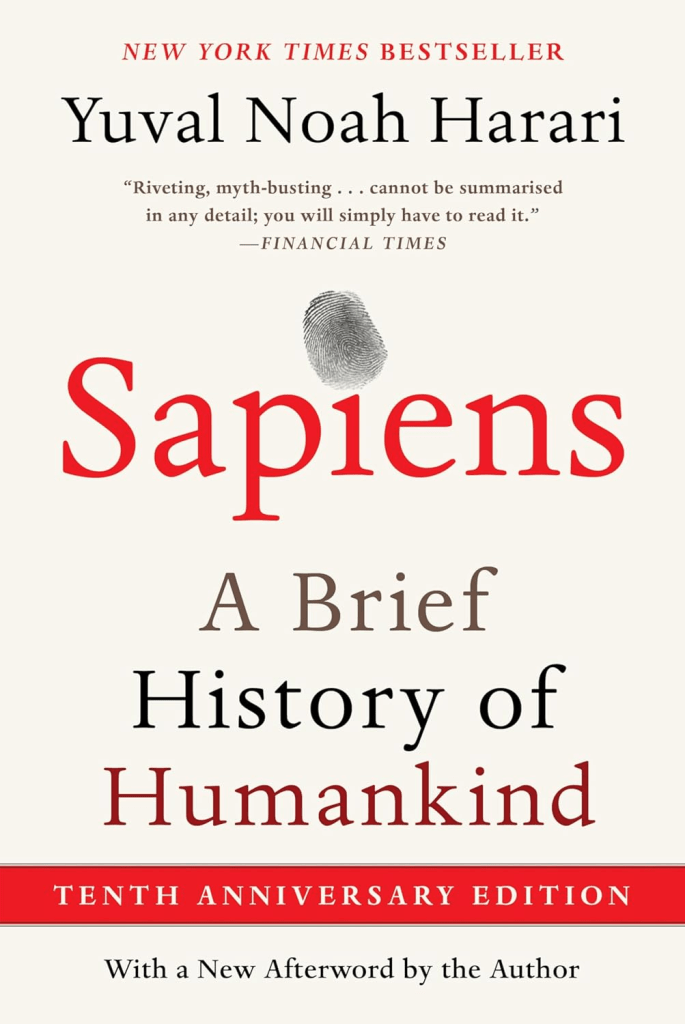
Let’s be honest. You’ve probably heard of Sapiens by Yuval Noah Harari, maybe even bought it, but never quite made it past chapter two. You’re not alone.
At over 400 pages of history, biology, economics, and philosophy, Sapiens is a modern classic that feels more like a marathon than a book. But what if you could get the essence of it, not a summary but the core insights, in ten minutes?
Let’s do exactly that.
Below are seven powerful takeaways from Sapiens that help explain who we are, how we got here, and why our world is built the way it is. These points go beyond summaries. They are ideas you will actually think about after you close this tab.
And if the book ever felt too long or too dense, this is where to start.
1. Humans dominate the Earth not because we’re strong, but because we believe in fiction
Around 70,000 years ago, humans experienced what Harari calls the Cognitive Revolution. It wasn’t about walking upright or using fire. Other animals did that too. The real game-changer was the ability to imagine things that don’t exist, talk about them, and convince others to believe in them.
Think about gods, nations, human rights, companies, and money. None of these things exist in nature. Yet, we organize our entire lives around them.
This ability to create and share collective myths gave Homo sapiens an edge over every other species. We cooperate in large numbers not because we are kind, but because we believe in the same stories.
The real superpower of humans is storytelling. That is what makes mass cooperation and civilization possible.
2. The greatest leap in knowledge came when humans admitted they didn’t know everything
One of the most profound ideas in Sapiens is this.
The scientific revolution began with humility.
Up until the 1500s, most societies believed they already had all the answers. These answers were often found in holy books or ancient philosophy. When faced with something unknown, people assumed it either didn’t matter or was unknowable.
But then something changed. Scientists started saying, “We don’t know, but we want to find out.”
That small shift in mindset led to everything from Newton’s laws to space travel.
In fact, old world maps before the 16th century were completely filled in, even if parts were imaginary. Later maps began leaving blank spaces. This was an honest admission of ignorance, which sparked exploration, curiosity, and massive technological progress.
Acknowledging that we don’t know something is not a weakness. It is the beginning of real knowledge.
3. Humans didn’t become rulers of the planet by being virtuous. We disrupted the ecosystem
Why are humans at the top of the food chain? Not because we were morally superior or stronger.
We simply moved too fast.
Harari points out that when predators like lions or sharks rose to the top, it took millions of years. This gave the ecosystem time to adapt. But humans rose in just a few thousand years, which is almost overnight in evolutionary terms.
Other animals had no time to adjust.
This led to mass extinctions and ecological damage. For example, many large mammals disappeared shortly after humans reached Australia and the Americas.
Our domination is not natural. It is disruptive. We are not the top because we fit in, but because we changed the rules too quickly.
4. Human progress does not equal human happiness
This one hits hard.
Yes, we have cities, smartphones, and life-saving medicine. But are we really happier than ancient foragers who roamed the land freely, ate a diverse diet, and worked fewer hours?
Harari argues that the Agricultural Revolution, which we usually celebrate, was a mixed blessing.
It allowed population growth, but also introduced hard labor, poor diets, inequality, and disease. People settled down to grow wheat, but wheat ended up domesticating us.
The species succeeded, but the individuals may have suffered.
This idea leads to a haunting insight.
More people, more tools, more power, but not necessarily more joy.
5. Civilizations grow when people believe in the same imaginary rules
Humans didn’t build pyramids, nations, and corporations just because of tools or intelligence. We built them because we believe in shared fictions.
These shared beliefs are what Harari calls imagined orders, such as money, religion, and law. They aren’t real in the way gravity or atoms are. But they are powerful because we act as if they are real.
A dollar bill only has value because millions of people agree that it does.
Even things we cherish, such as human rights or democracy, are ideas we’ve created, believed in, and institutionalized. They are not biological facts. They are collective beliefs that structure our world.
If enough people believe in the same story, it becomes the reality we live in.
6. Capitalism works because people believe tomorrow will be better
Why would someone lend money or take out a loan to start a business? It only works if both sides believe in a common story. That story is that the future will be bigger, richer, and better.
That is the core of capitalism. It is not just about money.
It is about trust in future growth. Harari explains that modern economies are built not just on hard currency, but on credit. Credit only exists when there is belief in future returns.
This belief has driven explosive progress, but it also led to things like colonialism, slavery, and climate change. Capitalism is powerful, but not always moral.
Capitalism depends on the story that growth is endless. But what happens when that story stops making sense?
7. We live inside systems we’ve created, but we forget they’re invented
Today, we take certain values for granted.
Freedom, equality, patriotism, success. But none of these are universal truths. They are ideas we have invented, accepted, and passed down.
The most dangerous myths are the ones we forget are myths.
From ancient religions to modern nationalism, humans are storytelling animals. That is both our strength and our weakness. We can unite by the billions or divide just as easily.
History is not just what happened. It is the stories we chose to believe about what happened.
So… What’s the real message?
Let’s go back to a question many readers ask.
If civilization has advanced so much, why doesn’t it always feel better?
That is the key idea Harari wants us to wrestle with.
We have conquered nature, built empires, and explored galaxies, but still struggle with loneliness, burnout, and meaning.
Progress is not always personal.
The human species may be thriving, but the individual human is not always doing better.
That is not to say things were better in the past. But Sapiens makes us question the automatic assumption that more is always better, and that newer is always wiser.
If the book felt overwhelming, just remember this:
- We rule the Earth because we tell stories
- Those stories only work if people believe them
- Belief, not truth, is the foundation of civilization
And if you never finish Sapiens, that’s okay.
Knowing these seven ideas might be even more powerful than reading all 400 pages.
Too long, too complex, too late to start reading the whole book? No problem. You just did.
 Site Title